
Clinical judgment in nursing is essential for safe, effective patient care—and it’s now a central focus of modern nursing education. With the adoption of the Next Generation NCLEX and the National Council of State Boards of Nursing Clinical Judgment Measurement Model (CJMM), nurses are expected to move beyond memorization and demonstrate strong decision-making in real-world scenarios.
Research shows that gaps in clinical judgment can lead to serious patient safety risks, particularly when nurses fail to recognize changes in condition or act on early warning signs. Strengthening clinical judgment requires not only understanding the CJMM framework but also applying it through curiosity, critical thinking, and practice.
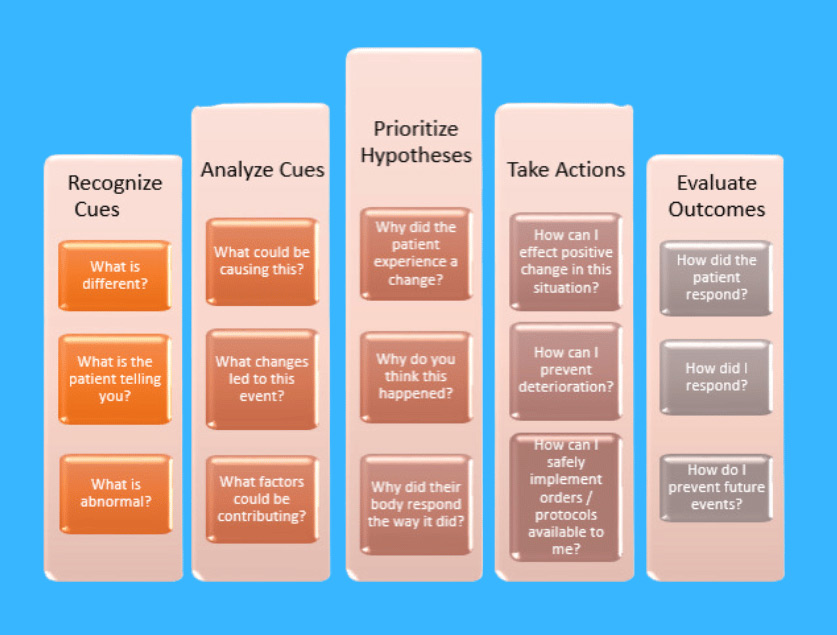
There are five components of clinical judgment in the CJMM: recognize cues, analyze cues, prioritize hypotheses, take action, and evaluate outcomes (NCSBN, 2019). When applied systematically, these steps help nurses make safer, more effective clinical decisions. One simple way to approach this process is by asking three key questions: What? Why? How?
As a nurse educator, I ask students, “Why?” more frequently than they wish, I’m sure. The more they answer that question, the more they make connections between the what, or subject matter, and the how or the actions that may address those findings. This connection supports decision-making based on understanding rather than assumption. I have created a graphic using the five domains of the CJMM to help guide this process and support strong clinical judgment.
Curiosity Invites Connection
A seasoned nurse knows through experience the cues of a deteriorating patient, but unfortunately, we cannot transfer our knowledge to our students, peers, or mentees. We can, however, thoughtfully unravel the process by which we understand that a patient has had a status change. For a novice nurse, this process may take more time and require confirmation by another. For a well-experienced nurse, this could take mere seconds. What happened? Why did it happen? How do I address it?
Curiosity Keeps Us Cautious
Using these three simple words to begin each series of questions can be a guide to any nurse who needs to gain confidence and competence in clinical decision-making. At their most simplistic, these questions can keep us moving forward in decision-making rather than being stuck in indecision. We notice systematically that the what leads to the why, and the why guides us to the how. We cannot forsake any step in this process lest our patients receive incorrect treatment or unsafe nursing actions.
Curiosity Helps Us Care
Identifying the gap in clinical judgment offers an opportunity for students, educators, and all nurses to examine our processes and practices of inquiry. Learning this process, like any other, requires repetition and intention. You can make better choices when you ask better questions. Whether you are a student, a staff nurse, or an educator, I hope that the What? Why? How? of clinical judgment will help you as you continue forward in your nursing career. Keep learning.
Applying Clinical Judgment Through Case Studies
One of the most effective ways to strengthen clinical judgment in nursing is through case-based learning. Case studies allow students and practicing nurses to apply the CJMM framework—recognizing cues, analyzing data, prioritizing hypotheses, taking action, and evaluating outcomes—in realistic, practice-based scenarios.
For example, a case study involving a patient with subtle changes in vital signs can challenge learners to recognize early signs of deterioration, analyze contributing factors, and determine the most appropriate next steps. Working through these situations builds confidence and helps nurses develop the ability to make timely, informed clinical decisions.
Research supports the use of case-based learning and simulation to improve clinical reasoning and decision-making in nursing practice. Studies have shown that structured case scenarios help bridge the gap between theory and practice while reinforcing critical thinking skills (see this case-based learning in nursing education study and this teaching clinical judgment in nursing education).
By repeatedly applying knowledge in context, case-based learning strengthens the connection between thinking and action—an essential step in developing strong clinical judgment.
For nurse educators, incorporating case studies into coursework creates opportunities for students to practice clinical judgment in a safe, structured environment before entering real-world practice.
Stay curious!
This article was originally published in May 2024 and updated in May 2026 to reflect new information.