
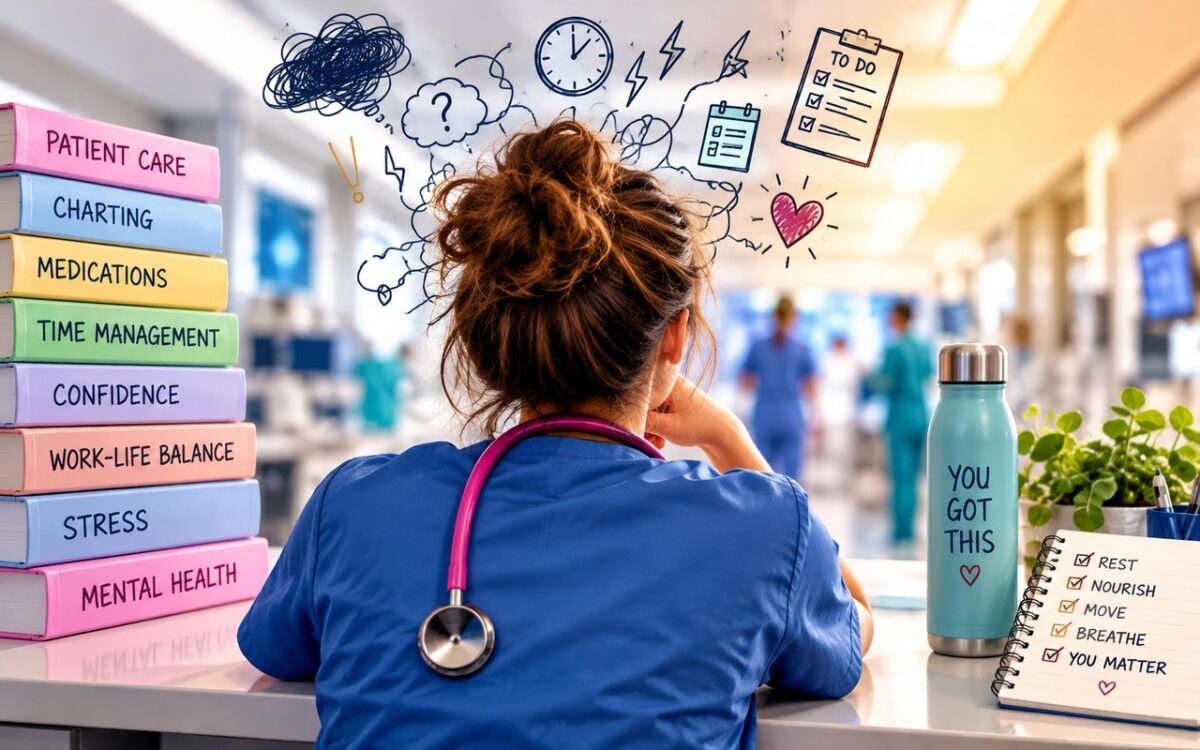
Nursing school prepares students to care for patients, but it can be harder to prepare them for the emotional weight of becoming the person responsible for those patients.
For newly licensed nurses, the transition can mean navigating unfamiliar clinical situations, making consequential decisions, and worrying about mistakes, often while working long shifts and adjusting to a new workplace.
“In school and clinicals, you’re never really the one holding it,” says Navjot “Navi” Hughes, PMHNP-BC, a psychiatric mental health nurse practitioner and founder of Empower Mental Health who previously spent eight years working in intensive care, progressive care, and emergency departments.

“The nurses don’t let you take over, so you graduate, and suddenly you are the one holding it, and it’s terrifying.”
That experience is often described as transition shock.
A systematic review and meta-analysis published this year in Nurse Education in Practice examined 31 studies involving 13,210 newly graduated nurses and found moderate levels of transition shock. Factors associated with the transition included self-efficacy, resilience, leadership, social support, the nursing work environment, and night shift frequency.
The research shows why telling new nurses to be more resilient is not enough.
When Stress Starts Following Nurses Home
Some anxiety and uncertainty are expected during the first year. New nurses are developing clinical judgment and confidence while caring for patients whose conditions can change quickly.
Hughes says the adjustment includes learning to remain grounded while being pulled in multiple directions.
“You constantly feel on edge, because you might miss a lab, you might miss a phone call, you might miss something important, and somebody’s life depends on it.”
The question is when expected first-year stress becomes something more.
“Some anxiety is normal, but you can tell it’s tipped into something more when it starts following you home,” Hughes says.
That might mean nightmares, being unable to enjoy days off, or feeling emotionally absent while spending time with family.
“When it starts taking your sleep, your days off, and the parts of your life that have nothing to do with the job, that’s the sign your mental health is starting to suffer.”

Shebna N. Osanmoh I, PMHNP-BC, a board-certified psychiatric mental health nurse practitioner with Savant Care, says persistent insomnia, changes in appetite, depression, difficulty maintaining relationships, and increased alcohol use are among the signs that a nurse may need additional support.
“If you stop enjoying life altogether and feel depressed, you require support,” Osanmoh says.
Thoughts of self-harm require immediate professional help rather than waiting to see whether they improve with time.
A Bad Shift Doesn’t Have to Become “I’m a Bad Nurse”
For nurses still developing their professional identity, criticism, mistakes, and difficult patient interactions can become judgments about whether they belong in the profession.
Tim Shurr, MA, a human behavior expert and author of One Belief Away!, says new nurses can begin interpreting individual experiences as evidence about their overall competence.

“A patient’s anger becomes ‘I’m a bad nurse.’ A mistake becomes ‘I’m not cut out for this.’ Constructive criticism becomes ‘I don’t belong here,’” Shurr says.
He encourages nurses to separate what happened from what they decided the experience meant about them.
After a difficult encounter, that can mean asking: What happened? What did I make it mean about me? What can I learn or do differently?
The goal isn’t to dismiss criticism or avoid accountability.
“I made a mistake, and I can learn from it,” Shurr says. “I received criticism about something I can improve.”
If a clinical error occurs, the nurse still needs to follow appropriate reporting procedures, take corrective action, and learn from it. But Shurr says a mistake can provide information without becoming an identity.
Research published in Nurse Education in Practice this year also identified professional role development, organizational and interpersonal support, and psychological resources such as resilience and self-efficacy as important to the transition.
Small Skills Can Help, but So Can Sleep
Not every strategy for managing stress requires a lengthy intervention.
Osanmoh recommends brief breathing or grounding exercises during stressful shifts. Slow breathing with a longer exhale can take about a minute. A grounding exercise can involve deliberately noticing sights, physical sensations, and sounds in the immediate environment to redirect attention from racing thoughts.
But coping techniques cannot replace recovery.
Osanmoh says chronic sleep disruption can worsen anxiety, contribute to mood changes, and affect concentration and judgment, a particular concern for nurses making clinical decisions.
“I think sleep is a part of the work, not outside the work schedule,” he says.
Hughes also cautions newly licensed nurses against immediately filling their schedules with overtime.
After years in school, the chance to earn more can make extra shifts tempting. But nurses who are still learning may need more recovery time, she says.
“Your days off are meant for taking care of yourself, not picking up extra shifts.”
Her advice is straightforward: prioritize sleep, take breaks that allow for movement and recovery, and establish mental health support before reaching a crisis.
Shurr recommends creating a deliberate transition out of work mode, whether that means taking several breaths after leaving the hospital, listening to music during the drive home, or developing another routine that marks the end of the shift.
“You can care deeply without carrying everything home with you,” he says. “Compassion does not require emotional absorption.”
Can These Skills Make a Difference Before Burnout?
Some research suggests that structured support can improve measures of well-being among newly licensed nurses, but the evidence does not show that resilience training alone can prevent burnout.
One program built around those types of skills is MINDBODYSTRONG™, an evidence-based cognitive-behavioral skills-building program designed to help nurses and other healthcare professionals strengthen coping and resilience, manage stress, and support mental health and well-being.
Research on the program has included newly licensed nurses as well as nurses experiencing mental distress. In a 2026 randomized controlled trial of 501 nurses, researchers compared mental health screening and referral with screening and referral plus an online version of MINDBODYSTRONG™. Nurses in the intervention group had a significantly lower risk of burnout at six months. The group also showed greater reductions in anxiety and depression and improvements in healthy lifestyle beliefs and behaviors during follow-up.
In a quality-improvement project published in the Journal for Nurses in Professional Development, researchers incorporated resilience and well-being training into an existing nurse residency program. The project reported improvements in both measures among participating newly licensed nurses.
Even with support available, other research shows how difficult the early months can remain.
Another study, involving new graduate oncology nurses, evaluated a resilience program that included education, individualized goals, mentoring, and a support group. Resilience scores declined significantly during the first six months, along with measures of professional quality of life and the new-graduate experience. Communication and organizational skills improved by 12 months.
Those findings do not establish what would have happened without the intervention. Still, they underscore why support for newly licensed nurses may need to continue beyond initial orientation.
Shurr says nurses should learn psychological skills before they are overwhelmed. That includes learning to receive feedback without turning it into a personal verdict, recognizing when stress spills into the rest of life, and developing an identity that doesn’t revolve entirely around work.
Even so, those skills have limits.
“A new nurse should not be expected to compensate for understaffing, inadequate orientation, bullying, or an unsafe workplace through better self-talk,” he says.
Asking Questions Shouldn’t Feel Dangerous
One of the simplest protections for a new nurse may also be one of the most important: feeling safe enough to say, “I don’t know.”
Hughes says fear of appearing incompetent can prevent nurses from asking questions precisely when they need guidance most.
“Asking questions is what keeps your patient safe, and it’s what builds your competence instead of exposing a lack of it,” she says.
She says the best preceptors and managers want new nurses to learn. They let them reason through decisions while staying available to step in and provide guidance.
Osanmoh says psychological safety extends beyond a nurse’s confidence.
If nurses believe asking a question is risky, they may start guessing instead, which could affect patient safety.
Residency programs, managers, and preceptors therefore have a role that extends beyond teaching clinical skills. Reasonable assignments, accessible mentors, consistent feedback, and a workplace that welcomes questions can shape how successfully a new nurse transitions into practice.
The 2026 meta-analysis supports that connection, identifying leadership, social support, and the nursing work environment among the factors associated with transition shock.
When It’s Time to Get Professional Help
New nurses may believe that struggling means they aren’t tough enough for nursing. Yet persistent symptoms should not be treated as a test of whether someone belongs in the profession.
Osanmoh recommends professional support when anxiety, depressed mood, insomnia, or relationship difficulties persist for more than a couple of weeks or begin interfering with daily life. Reliance on alcohol to cope is another warning sign.
Friends and colleagues can provide valuable support, he says, but they are not substitutes for mental health treatment.
Hughes encourages nurses to seek help sooner rather than later, particularly following traumatic events, workplace violence, or a patient’s death.
“The sooner the better,” she says.
The first year of nursing is a learning period that extends far beyond clinical skills. New nurses also learn to handle uncertainty, recover from difficult shifts, accept feedback, ask for help, and build confidence without expecting to know everything immediately.
Healthcare organizations also have something to learn during that transition.
New nurses can develop skills to manage stress. But those skills work best in environments where nurses have the time, support, and psychological safety to develop into the clinicians they are still becoming.

- The First Year of Nursing Can Be Brutal. Here’s How New Nurses Can Protect Their Mental Health - October 22, 2026
- You Can’t Self-Care Your Way Out of Burnout. So What Actually Helps Nurses? - October 20, 2026
- She Treats Addiction Through a Screen. Here’s What This Psychiatric NP Is Watching For - September 30, 2026