
For Daniela Vargas, MSN, MPH, MA-Bioethics, RN, PHN, a nursing school textbook presented an early rude awakening to racism in nursing. Vargas, who identifies as an indigenous brown woman and whose family came from Mexico, was shocked by the generalized depictions of people of color in the NCLEX prep book. “It was in a way a precursor to what I started to not only experience myself, but also with colleagues who are people of color, what their experiences were in the profession as I moved through nursing school and then post nursing school as well,” she says.

Vargas, a nurse since 2016, now serves as co-lead for the National Commission to Address Racism in Nursing. In January, the commission released an eye-opening survey on racism within nursing. The national study found that nearly half of the respondents reported widespread racism in the profession.
According to more than 5,600 respondents, racist acts are principally perpetrated by colleagues and those in positions of power, says a press release. Over half (63%) of nurses surveyed say that they have personally experienced an act of racism in the workplace with the transgressors being either a peer (66%) or a manager or supervisor (60%).
A subtler racism
Vargas says that the survey’s findings did not surprise her. Today’s racism, she says, may not be as obvious as the discrimination practiced in previous times. “I would say it’s less blatant and less in your face than it was perhaps in decades past.”
Healthcare institutions, notes Vargas, may come out with public statements against racism. “Yet the cultures that remain in many of the units where nurses work, that has not changed. It’s just they’ve evolved into being less in your face, and in a way people have gotten more sophisticated in how racism gets expressed.”
For instance, management or peers might make it harder for a nurse of color to obtain a promotion, she notes. Or staff nurses would refuse to work with student nurses of color during clinical instruction.
On top of nurse burnout and nurses leaving the profession because of the pandemic, “you have this compounded racism that faces many nurses already,” Vargas says. “And it’s built up over time. Especially for newer nurses, they go into nursing without the tools or the knowledge that this is occurring in the profession, and then once they’re in it, and they’re practicing, then they’re like, Whoa, what just happened? And I have not been taught how to address this, because it’s not something we learned in nursing school.”
“As I continued to go into the profession, I then finally was able to say, this is racism. I’m not just experiencing nurse bullying or incivility. It’s now become much more toxic and insidious than what I thought I was going into when I was in nursing school,” Vargas says.
Seeking solutions
In addressing racism in nursing, “the first thing that needs to be done is acknowledge that it exists,” Vargas says. Also, when onboarding a new nurse to an institution or unit, “there needs to be some built-in curriculum that has an antiracist standpoint to it, that comes with an expectation that this is not tolerated at this institution from the get-go.”
Serious accountability needs to be put into place, Vargas says. “There’s a piece of accountability that needs to be had in regard to what type of accountability measures an institution is doing, because saying that you want to be it is very different than the action.” For example, just as there are whistleblower hotlines for abuse or unethical behavior, hotlines could be established for racist behavior, she suggests.
Similarly, she says, licensing bodies can put in place mechanisms to report racism. “There has to be a real conversation in the nursing profession in regard to accountability of the individual nurse too” because racism affects not only patient care, the patient experience, and the community experiences but also affects colleagues as well. “I don’t think that we have enough measures currently in place that seek accountability on the side of nurses experiencing racism.”
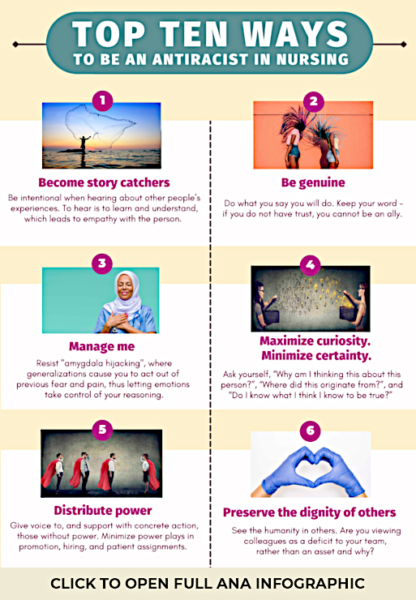
Along with the survey results, the commission released an infographic called “Top Ten Ways to be an Antiracist in Nursing.” It includes strategies such as distribute power, stop labeling others, and expose unwritten rules.
Launchpad for change
“What this survey did was really allow nurses of color to be able to share their lived experiences,” says Vargas. “And that is important because the voices of nurses of color are now being heard.”
“What this survey is a launchpad for, is to say this is no longer tolerated in the profession. It does not coincide with our code of ethics and we will be the generation that moves the profession forward in not tolerating it and allowing future generations to go without accountability.”

Now a freelance writer and editor, he served as a Director at Elsevier, where he was instrumental in the development of major online nursing reference and procedure products. Previously, he served as Editorial Director at Nurses.com, one of the first nursing websites, and was Executive Editor at Nursing magazine, a premier large-circulation journal.
Today, he continues to serve nurses and other clinicians by reporting on developments and trends in healthcare with meaning, context, and insight.
- VA Nurses Struggle in Uncertain Times - May 5, 2025
- Americans Believe AI Will Improve Healthcare, But Concerns Exist, Survey Finds - April 7, 2025
- Globalism, Racism, and Duty Among Updates in Revised ANA Code of Ethics - March 27, 2025