
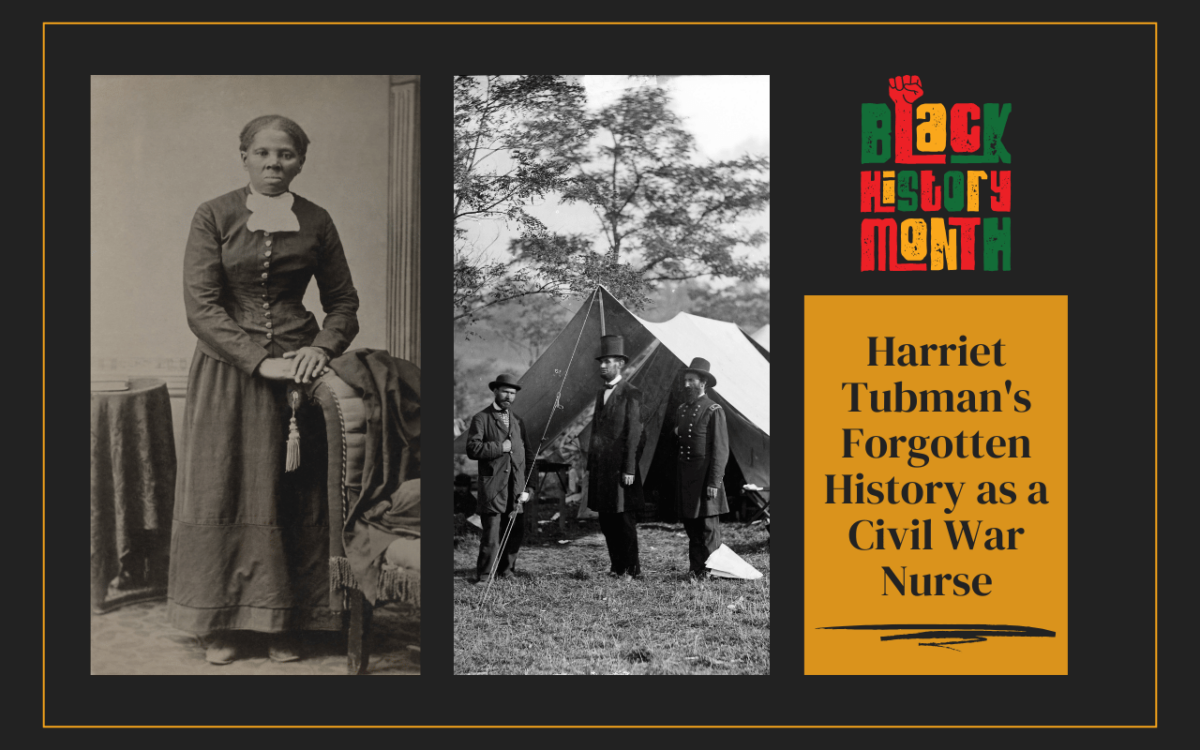
Harriet Tubman lived a life of advocacy, courage, and fearlessness as a conductor of the Underground Railroad, a system of safe houses and escape routes from slavery across America during the Civil War.
However, not many people know that she also was a nurse at one point. She often took care of her passengers on their way to freedom, and this experience helped her serve as a Civil War nurse, where she cared for hundreds of wounded soldiers and nursed them back to health.
Learn more about Tubman’s diverse background as a revolutionary hero and hidden nurse icon through her heroic acts that led the way to reform and freedom for Black Americans in the past.
Harriet Tubman’s Past as a War Nurse
As a Union Army nurse during the 1800s, she nursed wounded soldiers through her knowledge of medicinal herbs, a skill she learned from her mother. She took cranesbill and lily roots grown near where her patients were dying and made remedies that cured soldiers of diseases such as malignant fever and smallpox.
She could also get rid of dysentery, a gastrointestinal disease that was common at the time and was even recruited by army surgeons to heal soldiers at a military base in Florida.
Harriet Tubman traveled to various parts of the United States as a nurse. In 1862, she made her way to Beaufort, South Carolina, to care for the Gullah people. These individuals were formerly enslaved Black Americans who their enslavers had abandoned during a wartime evacuation on South Carolina’s Sea Islands.
While there, Tubman assisted them with basic necessities, including running an “eating house” and a “wash house,” where many women learned how to wash clothes and bake goods to become self-sufficient.
She was also appointed as a matron in 1865 at a hospital in Fort Monroe, Virginia, caring for wounded Black soldiers. Tubman also served as a Union spy, using the navigation skills she gained as a conductor to assist with raid planning and reconnaissance missions.
Many Black women served as nurses during the Civil War, including abolitionist Sojourner Truth and Susie King Taylor, an educator and one of the first nurses of the Civil War. In fact, many women became first-time nurses since their services were crucial during battles. Black nurses were at the forefront of care on Union hospital ships like the Red Rover and hospitals where they usually had no formal training.
Some nurses were paid for their work, including Ann Stokes, one of the first women to become a nurse in the Navy. She was also the first (and only) Black woman to draw a pension from the Navy through her service in the Civil War.
Unfortunately, Tubman did not receive pay or pension during her time as an army nurse. Her pension from her husband’s service in the war was increased from eight dollars to twenty dollars a month in 1899, but this was the only recognition given to her service at the time.
Harriet Tubman’s Home for the Elderly
During the last years of her life, Tubman finally achieved her dream of opening a charity home for older adults. The Harriet Tubman Home for the Elderly was built in 1908 to care for improvised elderly people in her community for free. The home continued to care for residents until her passing in 1913. Today, it is considered a national historic landmark and is available for tours.
Harriet Tubman was an activist and a humanitarian and expert nurse who took on the roles we see in nurses today to care for those who needed help. Nurses today can embody her advocacy spirit and compassion for themselves and the patients in their care.

- How Nurses Can Handle Bad Days at Work and Bounce Back Stronger - December 29, 2025
- How to Recognize When You Need to Take a Break - December 24, 2025
- Back by Popular Demand: How to Deal with Feelings of Inadequacy as a New Nurse - December 5, 2025