
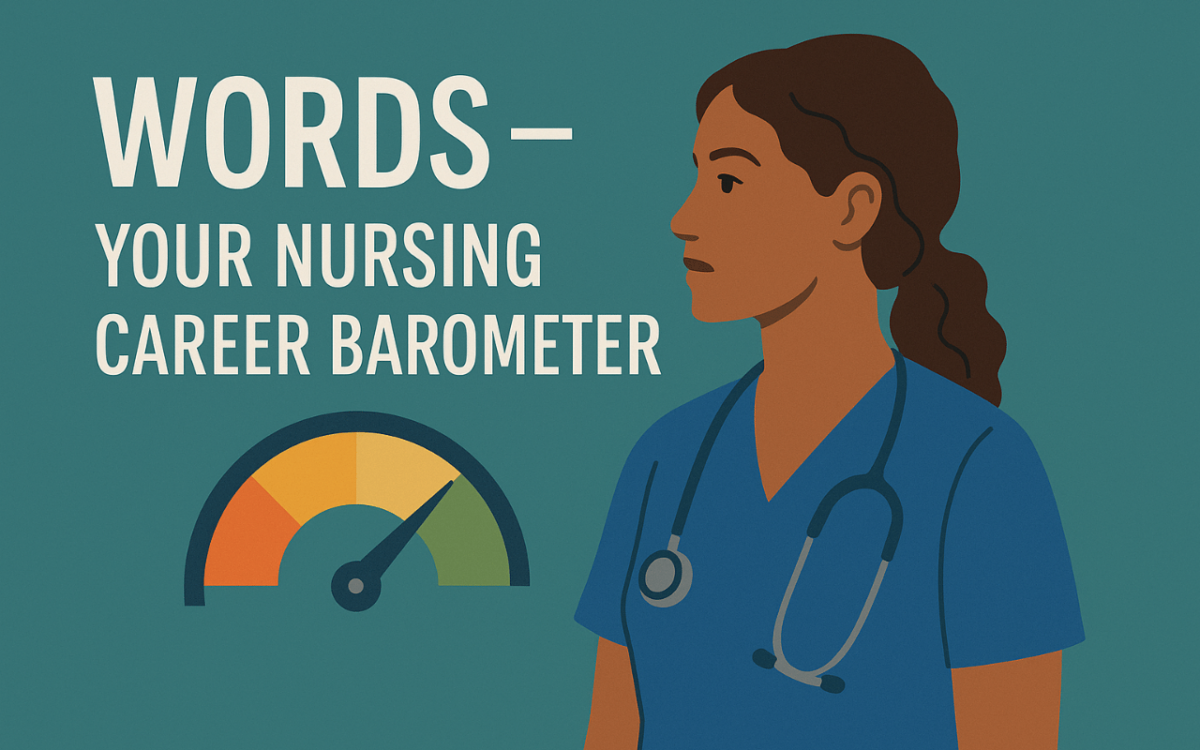
No matter where you are in your nursing career, the words you use are powerful. How you talk to your patients and colleagues says a lot about you, and how you talk about your work and your life says even more.
You also need to consider how you talk to yourself. Are you choosing empowering, positive words that indicate your passion, expertise, and professionalism? Or are you stuck in a defeatist loop?
Bad Stuff Happens
We all have bad days, and we also need to be careful of using negative language that can paint us into corners filled with bad feelings and negativity, which can contribute to burnout.
What words do you use when referring to your nursing career and your work in healthcare? Even if things are bad, can you reframe your experience and find ways to see it in a different light?
Let’s face it: bad stuff happens in healthcare: patients die, colleagues freak out, and the feces hits the fan in all sorts of ways. However, those bad times are the moments when it’s most crucial to keep perspective and not lose sight of the big picture.
When things are going south, we must remember that it’s not always this way. We can also remember that even the worst shifts will eventually end (like how all bleeding eventually stops).
Having said that, being in the thick of it is never a picnic, and sometimes, we just need to complain. Engaging in time-limited bitching sessions is usually fine, especially when we maintain awareness that they’re short-lived. The negative stuff doesn’t usually happen all the time, so hopefully, that keeps our complaints from being aired 24/7.
Breaking the Pattern
When things are wild at work, it’s an actual skill to distinguish what’s an anomaly or one-time event from an ongoing pattern.
Are there too many people in your unit who drag everyone down with negativity? Are their bullies who make everyone’s lives hell?
If you have a bad day every week or two but the rest isn’t so terrible, recognize and verbalize that reality. Instead of saying or thinking, Man, work was awful today; I hate my job, you could say or think, Man, what a rough day but most of my workdays aren’t that bad; I bet tomorrow will be better.
Catching a pattern of complaints and dismissing anything that’s good out of hand may be a sign you need a break. If you can’t see any clear sky among the storm clouds, consider whether you or your work environment or colleagues are at the heart of the matter.
If things are bad every day and your workplace truly feels out of control, this may be a pattern you don’t have the power to change. If there’s nothing but negative things to say about work, you need an attitudinal adjustment or a new job. Complaining occasionally is fine to blow off steam, but a pattern of complaining belies something else that’s going on and needs to be addressed, which can sometimes mean getting the heck out of there.
Words Matter
Using the term just to describe anything about your nursing career is a total no-no. I’m just a nurse doesn’t fly what are you trying to say when you stick the word just into that sentence?
When you say you’re just a nurse, you’re automatically diminishing your importance and your impact as a healthcare professional. I’ve even heard someone say, Well, I’m just a circulating nurse in the OR. A circulating nurse is a fantastic accomplishment and position. Does a doctor ever say, I’m just a doctor or I’m just a surgeon?
Saying that you’re just a nurse gives us a clue that you may be hiding behind being a nurse. This can mean you’re giving away your power because other team members are more educated or have more initials after their names. This can also be seen as a cop-out where you consciously remain in the shadows. Nurses have historically spent plenty of time in the shadow of physicians over the centuries why perpetuate that dynamic with your words?
Nurses resumes and cover letters often describe their feelings about themselves. I’ve seen plenty of documents that simply don’t reflect the knowledge, skills, and expertise that many nurses are blessed with.
Ask yourself these questions:
- Does my resume offer a sufficiently dynamic description of my nursing career?
- Do I hold back when I speak or write about my career and who I am as a nurse? If so, why?
- How can I up the ante in my use of career-related language?
- Am I afraid to own my expertise, skill, and knowledge? What am I afraid of?
A Language Tune-Up
If you need a tune-up of the language you use to describe your value as a nurse, it’s never too late. You can consciously take your resume to the next level, learn to sell yourself more powerfully in a job interview, and showcase what you bring to the table.
When you catch yourself or another nurse using the word just before they say a nurse, you have some work to do. Name it, call it out, and choose to delete that word when describing your career. No more hiding or self-deprecation your nursing career needs you to improve your language.
What you say and how you say it has power. Your ability to speak truth about being a nurse couldn’t be more critical since it reflects your professionalism and how you see yourself.
Words as a Career Barometer
If you have nothing positive to say about your job, consider whether it’s you or the job. Are you projecting negative feelings about yourself onto your work situation, or do your environment, colleagues, or patients bring out the worst in you because it’s a bad fit or a negative workplace culture?
If you’re caring for the wrong patient population, that can be changed. If your colleagues are downers or bullies, maybe you’re just stuck in a rotten workplace and need to quit and go elsewhere. And if the administration or managers offer nothing but criticism, perhaps you need to fly the coop.
Check your language barometer. Are you choosing to describe your work life in positive, forward-thinking terms? If negativity is the order of the day, is there something you need to change inside yourself, or do you need to escape your current job? Are you burnt to a crisp? Is your current work situation simply untenable? Words can be a powerful barometer of what you need to do to take your nursing career and self-esteem to the next level.

- Nurse Side Hustles: How Nurses Are Creating New Income Opportunities - April 23, 2026
- How to Become an FNP: Career Path, Requirements, and Certification - April 9, 2026
- Your Nursing Career on Your Terms - August 21, 2025