
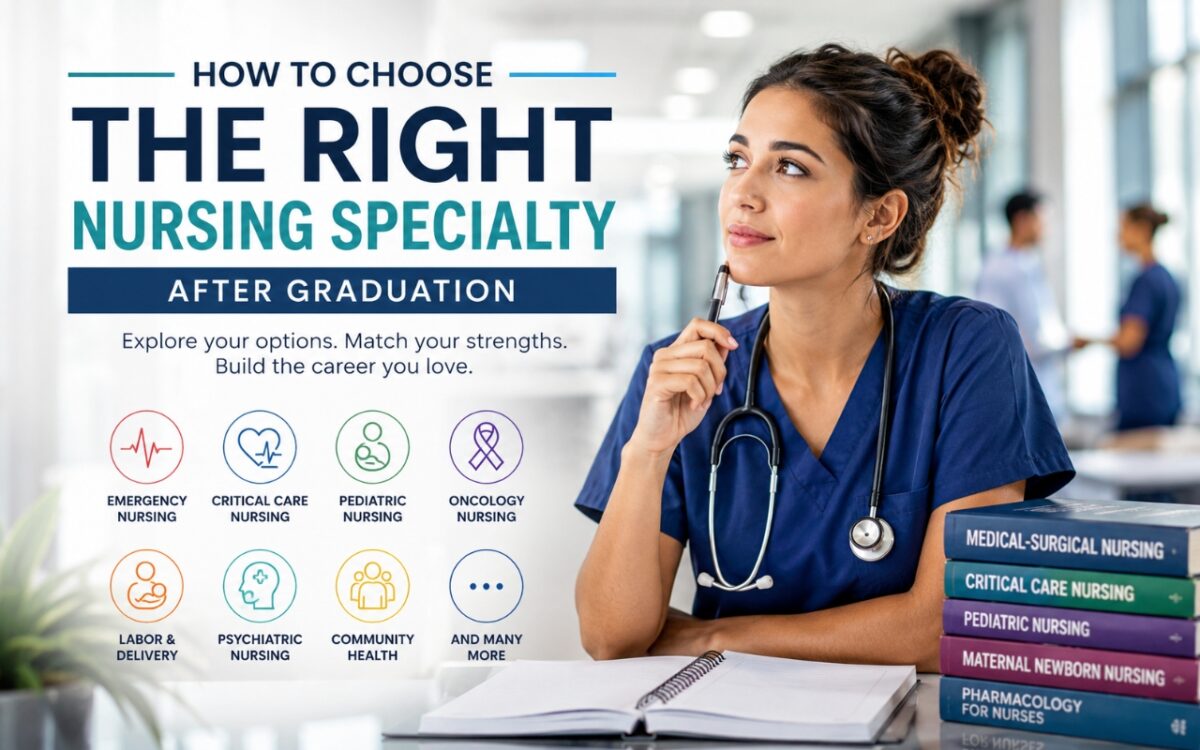
Graduating from nursing school is a milestone worth celebrating. But once the excitement of passing the NCLEX and landing your first job interviews begins to settle, many new nurses find themselves facing another big question:
Which nursing specialty is right for me?
With dozens of career paths available, from emergency nursing and critical care to pediatrics, oncology, labor and delivery, and community health, it can be difficult to know where to begin. Every specialty offers unique opportunities and challenges, and choosing your first job can feel like a decision that will shape your entire career.
The good news? It doesn’t have to.
Many nurses change specialties several times throughout their careers as they discover new interests, develop new skills, or pursue advanced education. Your first nursing position is an important step, but it’s only the beginning of your professional journey.
Quick Self-Assessment: Which Nursing Specialty Fits You?
Ask yourself these questions before you begin your job search:
✓ Do I enjoy fast-paced, unpredictable situations?
✓ Do I prefer building long-term relationships with patients?
✓ Am I energized by technology and complex clinical care?
✓ Do I enjoy teaching patients and families?
✓ Which clinical rotation did I look forward to the most?
✓ What type of work environment helps me do my best work?
Your answers won’t point to a single “perfect” specialty, but they can help you identify practice areas that align with your interests and strengths.
As you explore different nursing specialties, educational resources such as textbooks and clinical references can provide a deeper understanding of what day-to-day practice looks like in each field.
Why Choosing a Nursing Specialty Feels So Overwhelming
If you’re feeling uncertain, you’re not alone.
Unlike many professions, nursing offers an incredible variety of career paths. Some nurses thrive in fast-paced emergency departments, while others prefer building long-term relationships with patients in oncology, primary care, or hospice. Some enjoy the technical challenges of critical care, while others find fulfillment in educating patients and promoting wellness in community settings.
Because there are so many options, it’s easy to wonder whether you’re making the “right” decision.
The reality is that there is rarely one perfect answer.
Your first specialty should provide opportunities to strengthen your clinical judgment, develop confidence, and continue learning. As you gain experience, you’ll also gain a better understanding of the type of work environment, patient population, and pace that best fits your personality and career goals.
Many experienced nurses will tell you they never expected to end up in the specialty they love today.
Did You Know?
Nearly every experienced nurse can point to a moment when their career took an unexpected turn. Many begin in one specialty and later transition into another as they discover new interests, pursue advanced education, or take advantage of new opportunities.
One of nursing’s greatest strengths is the flexibility to grow and evolve throughout your career.
Questions to Ask Yourself Before Choosing a Specialty
Before comparing specialties, spend some time reflecting on what motivates you as a nurse. Your answers can help narrow your options and point you toward practice settings where you’re most likely to thrive.
What patient population interests you most?
Think back to your clinical rotations.
Were you energized while caring for children? Did you enjoy working with older adults? Were you fascinated by complex critical care patients, or did you find the greatest satisfaction in helping patients manage chronic conditions over time?
Your preferred patient population is often one of the strongest clues to finding the right specialty.
What type of work environment do you enjoy?
Every nursing unit has its own pace and culture.
Ask yourself whether you prefer:
- Fast-paced, unpredictable environments
- Structured routines
- High-acuity patient care
- Long-term patient relationships
- Team-based collaboration
- Independent decision-making
- Patient education and prevention
There are no right or wrong answers—only preferences that may make one specialty a better fit than another.
How do you handle stress?
Some specialties require rapid decision-making and constant multitasking. Others allow more time for patient education, discharge planning, or relationship building.
Understanding how you perform under pressure can help you choose a practice area where you’ll feel challenged without becoming overwhelmed.
What are your long-term career goals?
Think beyond your first job.
Would you eventually like to become:
- A nurse practitioner?
- A nurse educator?
- A clinical nurse specialist?
- A nurse leader or manager?
- A researcher?
- A travel nurse?
Some specialties naturally provide experience that supports these career paths, making it worthwhile to think about where you’d like your nursing career to take you over the next five to ten years.
Compare Common Nursing Specialties
Every nursing specialty offers a unique combination of pace, patient population, work environment, and career opportunities. The snapshots below provide a quick overview to help you compare your options.
Medical-Surgical Nursing
Best for: Building broad clinical skills and gaining experience across a wide range of patient conditions
Typical setting: Hospital inpatient units
Common certification: Certified Medical-Surgical Registered Nurse (CMSRN)
Emergency Nursing
Best for: Nurses who thrive in fast-paced environments and enjoy rapid decision-making
Typical setting: Emergency department
Common certification: Certified Emergency Nurse (CEN)
Critical Care Nursing
Best for: Caring for high-acuity patients and managing advanced technologies
Typical setting: Intensive care unit (ICU)
Common certification: Critical Care Registered Nurse (CCRN)
Pediatrics
Best for: Nurses who enjoy caring for infants, children, adolescents, and their families
Typical setting: Children’s hospitals, pediatric units, and outpatient clinics
Common certification: Certified Pediatric Nurse (CPN)
Oncology Nursing
Best for: Building long-term relationships while caring for patients undergoing cancer treatment
Typical setting: Cancer centers, infusion clinics, and hospital oncology units
Common certification: Oncology Certified Nurse (OCN)
Labor and Delivery
Best for: Supporting women and families through pregnancy, childbirth, and postpartum care
Typical setting: Labor and delivery units and birthing centers
Common certification: Inpatient Obstetric Nursing (RNC-OB)
Psychiatric-Mental Health Nursing
Best for: Nurses interested in behavioral health, therapeutic communication, and mental wellness
Typical setting: Behavioral health hospitals, psychiatric units, and community mental health centers
Common certification: Psychiatric-Mental Health Nursing Certification (PMH-BC)
Community Health Nursing
Best for: Prevention, patient education, and improving the health of entire communities
Typical setting: Public health departments, community clinics, schools, and home health agencies
Common certification: Advanced Public Health Nursing–Board Certified (PHNA-BC)
Once you’ve identified one or two specialties that interest you, consider exploring textbooks and clinical references in those practice areas. Reading beyond what you learned in nursing school can deepen your understanding of the patient populations, procedures, and clinical decision-making involved in day-to-day practice. Springer Publishing’s nursing collection includes specialty-specific textbooks, certification resources, and clinical references across more than 20 nursing disciplines.
Career Tip
Your first nursing job is a starting point—not a lifelong commitment.
Many experienced nurses work in several specialties throughout their careers. Every role helps you build clinical judgment, communication skills, and professional confidence that can open doors to new opportunities later.
Which Nursing Specialty Fits Your Personality?
Clinical skills can be learned. Personality is much harder to change.
That’s why choosing a nursing specialty isn’t just about the patient population—it’s also about finding a work environment where you can perform at your best.
While no nurse fits neatly into a single category, thinking about your natural strengths and preferences can help narrow your options.
If you enjoy variety and thinking on your feet…
You may thrive in emergency nursing, where every shift brings new patients, unpredictable situations, and opportunities to make rapid clinical decisions. Emergency nurses often care for patients of all ages and conditions, requiring strong assessment skills and the ability to prioritize quickly.
If you enjoy solving complex clinical problems…
Critical care nursing may be a good fit.
ICU nurses care for some of the hospital’s sickest patients while managing advanced technologies such as ventilators, invasive monitoring devices, and life-support equipment. The specialty rewards nurses who enjoy critical thinking, attention to detail, and continuous learning.
If you enjoy building long-term relationships…
Specialties such as oncology, rehabilitation, hospice, and primary care often allow nurses to develop lasting relationships with patients and families while supporting them through ongoing health challenges.
If you enjoy teaching and prevention…
Community health, public health, school nursing, diabetes education, and primary care frequently emphasize patient education, disease prevention, and helping people manage chronic conditions before they become more serious.
If you enjoy working with children and families…
Pediatric nursing combines clinical expertise with communication skills tailored to children at every stage of development while partnering closely with parents and caregivers.
The right specialty isn’t necessarily the most exciting or the highest paying—it’s the one where your strengths allow you to provide your best care while continuing to grow professionally.
Consider Your Lifestyle Along With Your Career Goals
Your work environment influences far more than your daily responsibilities. It also affects your schedule, work-life balance, stress level, and long-term career satisfaction.
As you compare specialties, consider questions such as:
- Am I comfortable working nights, weekends, and holidays?
- Do I enjoy the variety of 12-hour hospital shifts, or would I prefer a more predictable weekday schedule?
- Do I thrive in high-pressure situations, or do I perform best in calmer environments?
- How important is schedule flexibility?
- What type of workplace culture helps me succeed?
These questions don’t have right or wrong answers.
For example, some nurses love the intensity and teamwork found in emergency departments or intensive care units. Others find greater satisfaction in outpatient clinics, community health, hospice, or school nursing, where schedules may be more predictable and patient relationships often develop over time.
Burnout remains a challenge across healthcare, making it important to choose a specialty that aligns not only with your clinical interests but also with the way you prefer to work.
Questions to Ask During a Nursing Job Interview
Choosing a specialty isn’t just about the job title—it’s also about finding the right employer. Consider asking:
• Is there a formal nurse residency or transition-to-practice program?
• How long is orientation?
• What mentorship opportunities are available?
• What is the typical nurse-to-patient ratio?
• Are specialty certifications encouraged or reimbursed?
• What continuing education opportunities does the organization provide?
Asking thoughtful questions can help you determine whether an organization will support your growth as a new nurse.
Don’t Let Salary Be Your Only Guide
It’s natural to compare salaries when evaluating different nursing specialties. Compensation is an important consideration, especially for new graduates beginning their careers.
However, salary tells only part of the story.
Higher-paying specialties may involve overnight shifts, frequent weekends, emotionally demanding patient populations, or high-acuity clinical environments. Shift differentials, certifications, geographic location, years of experience, and employer also influence earning potential.
Instead of asking, “Which specialty pays the most?” consider asking: Which specialty will help me build the career I want?
Finding work that aligns with your interests often leads to greater professional satisfaction, stronger performance, and long-term career growth.
Which Nursing Specialties Are in Demand?
The demand for registered nurses remains strong across the United States, driven by an aging population, increasing healthcare needs, and workforce shortages in many practice areas.
While hiring needs vary by region and employer, hospitals and healthcare systems continue recruiting nurses in specialties such as:
- Medical-surgical nursing
- Emergency nursing
- Critical care
- Behavioral health
- Perioperative nursing
- Long-term care
- Home health
- Labor and delivery
Rather than focusing solely on current hiring trends, think about where you’ll have opportunities to continue developing your clinical skills.
Healthcare is constantly evolving. Nurses who build a strong clinical foundation and commit to lifelong learning often have the greatest flexibility to pursue new specialties as their careers progress.
Your First Nursing Job Doesn’t Define Your Career
Perhaps the biggest misconception among new graduates is that choosing a first specialty means choosing a lifelong career. It doesn’t.
Many experienced nurses have worked in several specialties before finding the one they love most.
A nurse might begin in medical-surgical nursing, transition into critical care, later become a flight nurse, and eventually move into education or leadership. Another may start in pediatrics before pursuing graduate school and becoming a pediatric nurse practitioner.
Every role builds transferable skills.
Communication.
Clinical judgment.
Patient assessment.
Time management.
Interprofessional collaboration.
These competencies become valuable no matter where your career takes you.
Rather than searching for the “perfect” first job, look for an opportunity that will challenge you, strengthen your confidence, and provide a supportive environment for learning.
A strong foundation during your first few years of practice can open doors throughout your career.
Think About Certification Before You Need It
When you’re graduating from nursing school, certification may feel like something to think about years down the road. In reality, understanding certification pathways early can help you make more informed career decisions from the very beginning.
Most specialty certifications require nurses to gain clinical experience before becoming eligible to sit for an exam. Understanding what these certifications require can help you identify the knowledge and skills you’ll develop as you gain experience in your chosen specialty.
For example:
- Emergency nurses often pursue the Certified Emergency Nurse (CEN) credential.
- Critical care nurses may earn the Critical Care Registered Nurse (CCRN) certification.
- Oncology nurses can pursue the Oncology Certified Nurse (OCN) credential.
- Pediatric nurses may work toward becoming a Certified Pediatric Nurse (CPN).
While certification isn’t required for every nursing position, many employers value specialty credentials because they demonstrate advanced clinical knowledge and a commitment to professional growth. Some organizations also offer salary incentives, clinical ladder advancement, or leadership opportunities for certified nurses.
Understanding these pathways early allows you to build experience intentionally and prepare for future milestones throughout your career.
As you advance professionally, specialty textbooks, evidence-based clinical references, certification review guides, and practice exams can help reinforce your knowledge and prepare you for certification. Springer Publishing’s nursing collection includes resources that support nurses from nursing school through specialty certification and continuing professional development.
Frequently Asked Questions
What is the best nursing specialty for new graduates?
There isn’t one “best” nursing specialty for every new graduate. The right choice depends on your interests, preferred work environment, personality, career goals, and learning style. Many nurses begin in medical-surgical nursing because it provides broad clinical experience, while others enter nurse residency programs in specialties such as critical care, emergency nursing, or labor and delivery.
Can new graduate nurses work in the ICU?
Yes. Many hospitals offer nurse residency or transition-to-practice programs that prepare new graduates for critical care nursing through structured orientation, mentoring, simulation training, and ongoing education. Requirements vary by employer.
Is medical-surgical nursing still a good place to start?
For many nurses, yes.
Medical-surgical nursing provides exposure to a wide variety of patient conditions, medications, procedures, and clinical skills. That broad foundation can make it easier to transition into other specialties later in your career. However, it isn’t the only path. Many healthcare organizations now offer residency programs that allow new graduates to begin directly in specialty practice.
Which nursing specialty pays the most?
Compensation varies based on geographic location, employer, years of experience, certifications, education, shift differentials, and demand. While salary is an important factor, choosing a specialty based solely on earning potential may not lead to long-term career satisfaction.
How often do nurses change specialties?
It’s common for nurses to work in multiple specialties throughout their careers. Skills developed in one practice area—such as communication, clinical judgment, patient assessment, and teamwork—transfer well to many other settings.
What if I choose the wrong specialty?
There’s good news: very few nursing career decisions are permanent.
Many nurses discover new interests after gaining bedside experience and successfully transition into different specialties, leadership roles, education, informatics, research, case management, or advanced practice nursing.
Your first nursing position is an important learning experience—not a lifelong commitment.
Your Next Step
Choosing your first nursing specialty is an exciting milestone, but it’s only the beginning of your professional journey.
Rather than trying to find the perfect specialty, focus on finding a role where you’ll continue learning, developing clinical confidence, and building a strong foundation for the future. As your interests evolve, nursing offers remarkable flexibility to explore new specialties, pursue advanced education, earn specialty certifications, and take on leadership opportunities.
No matter where your career begins, investing in your professional development can help you prepare for what’s next. Exploring trusted nursing textbooks, clinical references, certification review materials, and exam preparation resources can help you build the knowledge and confidence to grow throughout your career.
Whether you’re preparing for your first nursing position or planning your next professional milestone, the knowledge you build today will continue to serve you throughout your career.
Continue Your Nursing Journey
Ready to take the next step? Whether you’re preparing for the NCLEX, exploring a specialty certification, or deepening your clinical knowledge, Springer Publishing offers study guides, certification review materials, and digital exam preparation tools to support every stage of your nursing career.
Springer Publishing offers resources for every stage of the nursing journey, including:
Start Your Career
- NCLEX resources
- Nursing textbooks
- Clinical references
Advance Your Practice
- Certification study guides
- Practice questions
- ExamPrepConnect
Keep Growing
- Professional development
- Advanced nursing texts
- Specialty references
Ready to learn more? Explore Springer Publishing’s nursing collection to discover textbooks, certification review guides, clinical references, and exam preparation resources that can support you from nursing school through specialty certification and beyond.

- A Seven-Week Program Helped Critical Care Nurses Manage Stress and Anxiety - October 26, 2026
- The First Year of Nursing Can Be Brutal. Here’s How New Nurses Can Protect Their Mental Health - October 22, 2026
- You Can’t Self-Care Your Way Out of Burnout. So What Actually Helps Nurses? - October 20, 2026