
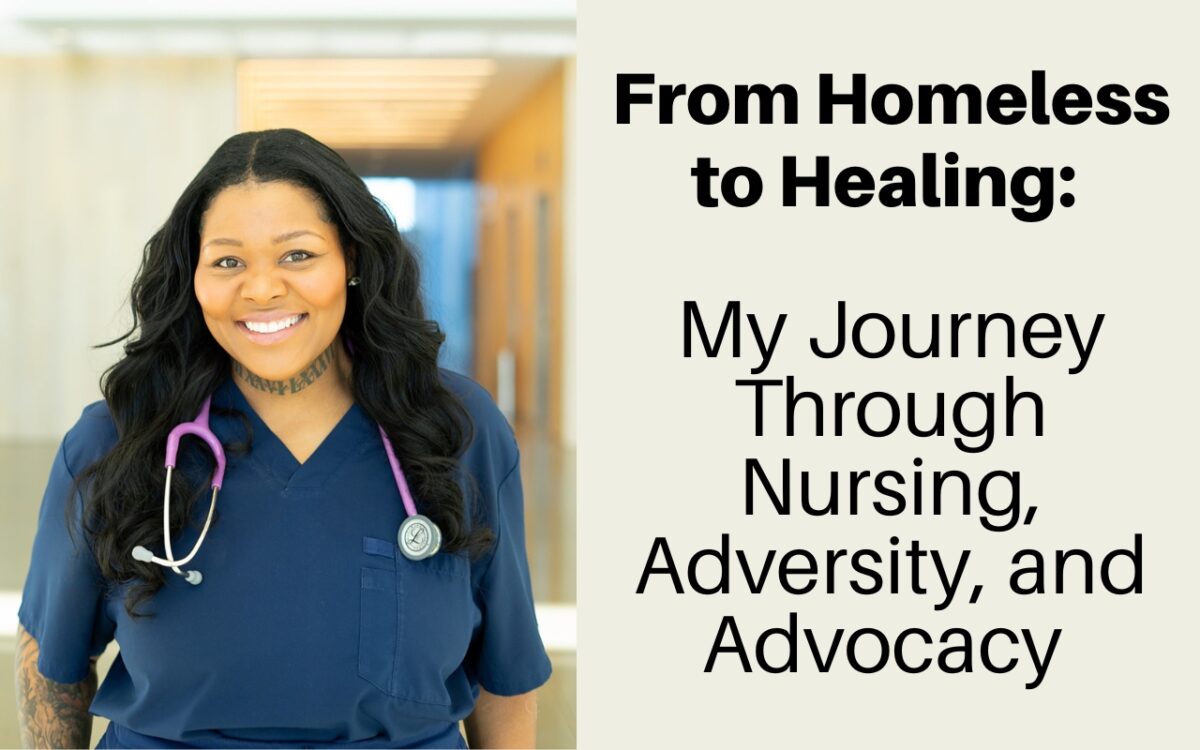
I grew up in Marietta, Oklahoma, in a home with five kids, full of structure, love, and faith. My parents did not have much — my dad worked in roofing, and my mom had to stop working after developing heart failure when I was in middle school. Both parents endured trauma that would break most people, but they poured love into us. Still, my parents gave us everything that mattered. I learned to say, “yes ma’am” and “no sir,” and to never settle for less than our best. Even though they did not go to college, a “C” on a report card or missing church meant you were grounded. That faith, love, and the responsibility I took on caring for my mom and neighborhood kids planted the seed for my nursing career. I love caring for people when they need it most.
Lesson: Resilience is a Skill, Not Just a Trait
My early caregiving role, faith, and family’s strength laid the foundation for my ability to persevere through adversity.
Pursuing a Nursing Degree While Facing Racism and Homelessness
I entered the University of Central Oklahoma as a pre-nursing student, and I was told to pick another major because “most students don’t get in.” I still applied, but I did not get in. The rejection letter said the school had too many qualified candidates. Fortunately, the University of Oklahoma’s nursing program did accept me. Still, I learned that being one of the few African Americans came with heavier expectations, less support, and limited opportunities for advancement — the same barriers I would face later as a nurse leader.
I got good grades and won awards, but one professor said I would never graduate because of my poor care plans. The dean let me know this instructor had a problem with African American students. I grew up with racism, but I did not recognize it in that moment. My parents taught me it was not a reflection of me but of others’ hearts.
I often worked two to three jobs to make ends meet, but financial aid was out of reach because my family was considered middle-class. I was proud but also broke. By my senior year, I was without stable housing. I slept in the nursing building, showered in the student gym, and ate leftovers from shared fridges. One assistant dean saw me sleeping and gave me $100. That small act of kindness meant everything.
Lesson: Kindness Can be Transformative
A simple gesture from a faculty member helped me feel seen and supported during my darkest moments. Always be a source of light for your patients.
I failed the NCLEX the first time I took the test, despite having a 3.8 GPA. I passed on my second try, but my mom passed away a few weeks later. I was devastated and confused. When I became an educator, I realized the mental impact of homelessness had taken a toll.
New Career, New Challenges
I began my nursing career in critical care and then transitioned into travel nursing, working in Houston, Connecticut, and New York. Fear was always my driver: fear of not having money, of being homeless again, of not having enough. That fear kept me moving, but it also wore me down.
Eventually, I earned my master’s degree and began teaching in Houston. I taught critical care, medical-surgical nursing, and pharmacology. When I started, the NCLEX pass rate was 68%. When I left six years later, it was 100%. I poured everything into my students because I knew what it was like to feel unsupported.
However, academia has not always been kind to me. I was reminded daily of how bias shaped perceptions of me. My passion was labeled as “aggression,” and my knowledge was considered “intimidation.” I was told, “Work less so you don’t make your colleagues look bad.” A leader once compared me to a white peer trainer and said, “You do not have to be better than her — just stay under her. No one is better than her.”
In contrast, an ally quietly reminded me, “Little brown girls need you.” That encouragement carried me through when the system tried to make me feel small.
Despite it all, I believed in the tools my parents gave me: faith, resilience, and the strength to fight for what I loved. I faced bullying, discrimination, and getting fired without cause. I filed an EEOC claim and won; I had to represent myself as my own lawyer. Many told me I was not a “good fit” more times than I can count. But I never stopped advocating — for myself or others.
Lesson: Advocacy Begins With Self
The courage to challenge injustice shows nurses how to stand up for their rights and demand equity.
Healing and Helping Others
My personal life was just as turbulent. I survived multiple abusive relationships. I endured beatings, getting arrested after calling the police for help, and being pushed to the brink. I attempted suicide twice. But my family and friends pulled me back. I joined a recovery program at church and began my healing journey. I also got diagnosed with heart failure, the same condition that took my mom, grandma, and aunt. But I kept going.
Eventually, I founded a ministry born from my pain and purpose. Then I heard about Nightingale College. The interview was affirming — unlike other spaces, they saw past my tattoos, skin color, and trauma and saw “me.” I started in March, and I have loved it ever since.
Nightingale’s mission is to advance health equity by preparing nurses who reflect the diversity of the communities they serve. Their vision is rooted in inclusivity, compassion, and access. What they did not know was that I had not worked in three months after being fired for being Black and excelling beyond a white peer. During my onboarding, I disclosed only that I was struggling financially. Instead of judgment, they quietly gave me money to eat — no questions asked.
Their support went beyond finances. Nightingale checked on my mental health, connected me with my first financial advisor, and offered free mental health resources, wellness incentives, and professional development opportunities — things I had never had access to before.
Then came a moment I will never forget.
Lesson: Mental Health Matters in Nursing Education
My experience underscores the importance of trauma-informed teaching and comprehensive support for nursing students.
At a work conference, I saw a massive Nightingale banner with an image of a Black woman that was placed on a Salt Lake City building. I cried tears of joy and immediately called my dad. For the first time in my career, I felt seen, valued, and supported as a whole person — not just as a nurse or educator.
Today, I teach clinical rotations across the country. More than that, I support my students holistically. I give each of them a box so they can write down their barriers and strengths. They can then “give it to God.” I follow up with them and connect them to resources. I have helped students facing homelessness, loss of a loved one, chronic illness, domestic violence, racism, suicidal thoughts, and financial hardship — because I have been there.
I tell my students, “Seventy percent of outcomes are psychosocial.” If you are not okay mentally, you cannot succeed academically. I model professionalism and resilience, even when we face racism at clinical sites. I remind them: “It’s not a ‘you’ problem — it’s a ‘them’ problem.”
I find joy these days in small things: wearing makeup, cutting my hair, and being myself. I wake up happy every day, knowing I am following my calling. My greatest misery has become my ministry, and I am just getting started.
Lesson: Lived Experience is a Teaching Asset
Empathy and authenticity made me a stronger educator and mentor.
Reflections for Nurses and Educators
I hope the nursing profession will open doors to diversity, equity, and inclusion — so that our communities can be built on love, trust, forgiveness, and healing. I encourage you all to tell the next little Black or brown boy or girl, “You can do it too. Here, hold my stethoscope.”
I believe in the power of perseverance, faith, and advocacy for nurses — especially those from marginalized communities. I hope my journey offers these enduring lessons:
- Resilience can be built through love, purpose, and support.
- Mental health must be prioritized in nursing education.
- Small acts of kindness can change lives.
- Advocacy starts with standing up for yourself.
- Lived experience enriches nursing education.
- Faith and purpose can be anchors in turbulent times.
- Representation matters — and it transforms the profession.
- She Treats Addiction Through a Screen. Here’s What This Psychiatric NP Is Watching For - September 30, 2026
- She Went From Broadway to Dementia Care. Now She Helps Nurses Understand What Behavior Is Saying - September 25, 2026
- What Causes Breast Milk Supply to Drop? What Nurses Should Know - August 18, 2026