
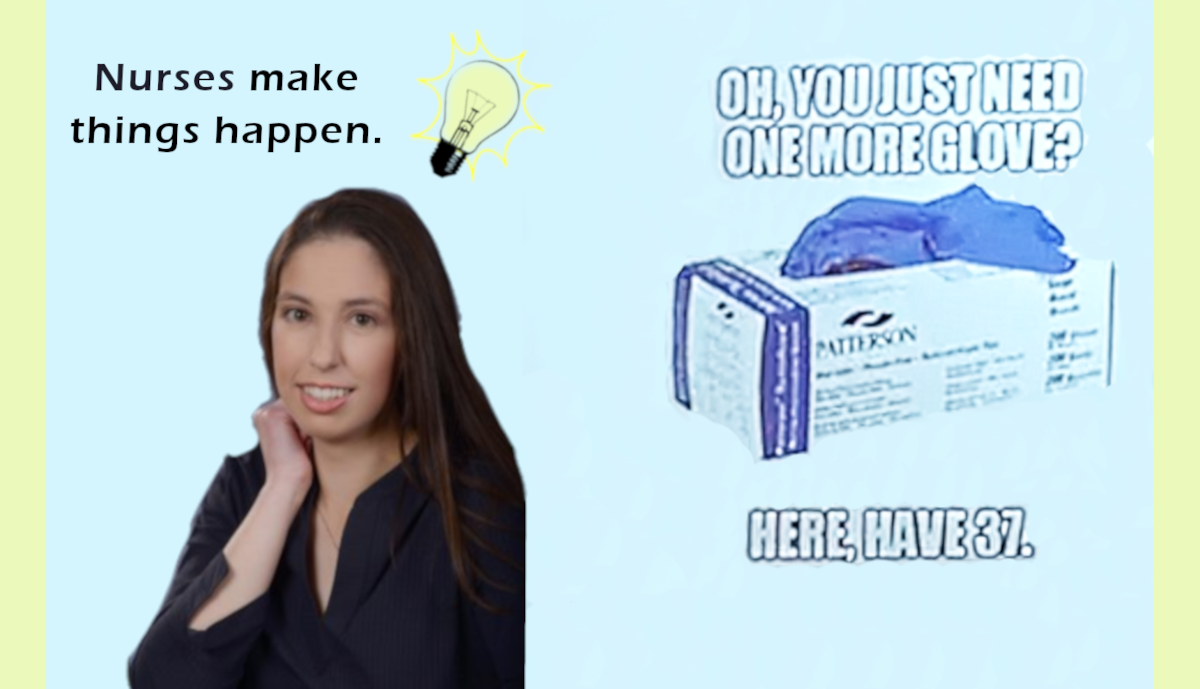
It happens to everyone, but nurses grit their teeth and bear with it every day. “It” is, of course, the profligate, Gaia-trashing cousin of the Missing Sock Phenomenon: The Redundant Glove Problem.
This is the dream: Your mask is on, and you reach out to grab a disposable glove. A single glove separates itself from its mates as you pull it out of the box. You pull it on, reach out, and swiftly extract another SINGLE GLOVE from the box. The other gloves remain inside the box and patiently wait for hands that want them. There are no wasted, now-useless single gloves littering the floor, and we have entered a world that doesn’t incessantly force health care workers to squander essential supplies.
New grad—Nurse of the Week Ellen Quintana, RN—is the nurse who just might make this dream a reality.
Luckily, when Ellen was still a freshman, she could not easily dismiss her first encounter with the Redundant Glove Problem (or RGP) during a chem lab class at University of Connecticut School of Nursing. As she told U Conn Today’s Mikala Green, “No one could get just one glove out of the box, and there were gloves everywhere. We were told that once they fell out, we couldn’t put them back; it was really wasteful.”
The vision of those scattered unwanted gloves bothered her. Quintana even surveyed her professors and found that the RGP plagued them as well. Looking ahead at a nursing career that would undoubtedly contribute a mountain of wasted “extra” gloves to the world’s landfills, Quintana realized this was more than a mere annoyance and started to analyze the problem. Even amid the intensity of her BSN program, she pursued a solution. The box opening, she determined, was the pain point—the “weak link” that allows those feckless gloves to flow so promiscuously. An adjunct faculty member suggested the freshman apply for the U Conn Idea Grant Program; she did, and her RGP-Killer project was awarded a grant!
Quintana soon found mentors, who helped her restructure her academic schedule to permit her to continue her nursing studies while concurrently developing her idea. She also partnered with the University of Connecticut Engineering and Design program and performed “pull tests” on proposed models. By spring 2020, she had acquired a partner (Kelsey MarcAurele U Conn NUR ’22), and their concept—now known as ReduSeal, a product in the making—won $10,000 at a university-wide innovation contest (second place). That summer, ReduSeal was also a finalist at the Johnson & Johnson Nurses Innovate Quickfire Challenge, and this year—not long before her graduation—Quintana became one of the few nurses to receive a patent when the US Patent Office awarded her a non-provisional patent for ReduSeal. At commencement, the U Conn School of Nursing presented her with the Regina M. Cusson Student Healthcare Innovations Award.
Ellen Quintana is scheduled to begin work this August as an Emergency RN at Hartford Hospital. And her RGP-killer, ReduSeal, is on its way to a career as well. She told U Conn Today, “I want to strategically license the product so hospitals can save money, reduce waste, and hopefully save time for nurses. Nurses shouldn’t have to clean up gloves.” Amen to that.
Be sure to check out the U Conn Today article on Ellen Quintana. It details the steps she took to develop her product and the resources that the School of Nursing and U Connecticut employed to support her project and her studies.
- Back by Popular Demand: Communicating with a Patient on a Ventilator: Tips from a Specialist - December 19, 2025
- Improve Your Communication and Relationship with Alzheimer’s Patients: A Guide for Nurses - March 13, 2024
- CRNA Helped Save Martin Luther King’s Life After 1958 Stabbing - February 2, 2024