
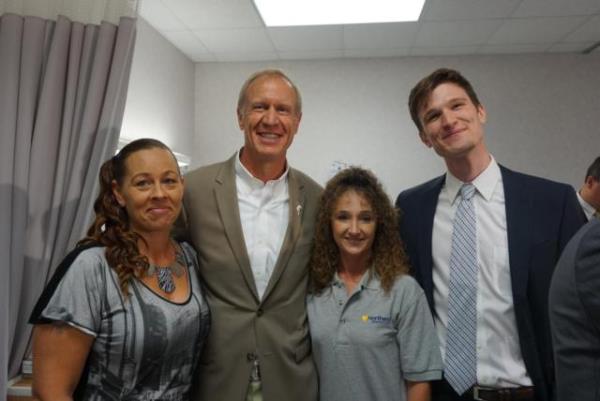
After 19-year-old and single mom Lisa Creason attempted to rob a Subway shop out of desperation to provide for her young daughter, she wound up spending the next two decades paying for her actions. Creason served just one year for her felony charge for attempted robbery, but it turned out to be a life sentence when the conviction stayed on her permanent record, barring her from any work requiring a professional license by state law. However, she never let the situation define her.
Now 43 years old, a mother of three, and a nursing school graduate, Creason watched last week as the Republican Illinois Governor, Bruce Rauner, signed a law that would give her the second chance she had been working toward since she left prison.
After leaving prison, Creason volunteered talking to at-risk youths to warn them about the repercussions of their actions. She also started a nonprofit to help kids who lost parents to gun violence after her own fiancé was killed by a stray bullet while sitting on their front stoop in 2002. Creason did both of those things while holding down restaurant and cashier jobs to support her family, but after her fiancé’s death, she wanted to find a stable career that would allow her to move her children out of their dangerous neighborhood and get off government assistance.
In 2005, Creason decided to become a nurse so she could give her children a better life. She started by receiving a nursing assistant certificate, then took a job in a local nursing home while going to school part time to take prerequisite classes to get into a nursing program. Creason was finally able to enroll in a community college nursing program in 2012.
When Creason passed her final two years later, she called her mother crying tears of happiness at the thought that she could finally provide more for her children. But she didn’t know that Illinois had passed a law in 2011 preventing people with felonies, including attempted robbery, from obtaining healthcare licenses. It wasn’t until she sent in the forms to take the state-mandated nursing board tests that she received a letter telling her she was ineligible to be a nurse. Devastated and angry that she had done everything right and worked measly jobs to get to where she was, she knew anger wasn’t an action move and wouldn’t get her to the next step.
Creason started researching the statute that prevented her from obtaining her nursing license, aided by paralegal courses she had taken in prison. She called the state department dealing with professional regulations to ask what she could do and was told by a sarcastic woman on the phone that her only options were to get her record cleared or get the law changed. So, the next week, Creason decided to visit the state capitol.
With no idea how to lobby politicians, Creason knew she needed to get her story in front of lawmakers. She felt that the law passed in 2011 had tremendous unintended consequences, and state politicians needed to realize it. Nobody wants to keep people on government assistance, but the law was doing exactly that. Almost a quarter of all jobs in Illinois require an occupational license, yet at least 118 of those licenses can be denied to people with a felony record. With more than 300,000 people released from Illinois prisons per year, close to 75 percent of those released nationwide remain unemployed a year after their release, and nearly 50 percent return to prison within three years.
As the last week of the legislative session approached in May, the bill that would give Creason and many others a second chance had yet to be called to the floor for a vote. Creason had driven 45 minutes to Springfield nearly every day, even after working an overnight shift at the nursing home and seeing her kids off to school the next morning, but her spirit was dwindling and she decided not to bother going on the very last day.
It was that last day, while she was at work at the nursing home, that Creason got a text to turn on the live-stream of the State House proceedings. Surrounded by her co-workers, Creason watched as her bill was passed 71 to 40. She cried watching the proceedings, and cried again last week while she watched in person as the governor signed the bill law allowing her to take her board exams and find a job as a nurse. The signing was held at Richland Community College where she had earned her nursing degree.
The new law specifically includes health care licenses, making eligible those who have passed more than five years since their conviction, or more than three years since their release from prison, whichever is greater. The state will still have discretion to deny applicants, and the law does not apply to sex offenders.
Creason said that what made the old law so unjust was that her children were being punished for something she did as a teenager over 20 years ago. Kids are the ones who suffer when their parents are limited, and they didn’t do anything wrong. She says she’ll save celebrating for when she passes her state exam, but she is finally hopeful for the future and knows that her children also learned a valuable lesson. Her kids know that anything is possible with hard work and determination, and that when people tell you that you can’t do something, you can never take it at face value and give up.
Congratulations to Lisa Creason, our Nurse of the Week, for helping pass such an important bill. We wish you the best of luck on your state exam.

- Nationwide Shortage of Sexual Assault Nurse Examiners Prompts Alternative Solutions from States - March 30, 2020
- Coldiron Senior Nurse Executive Fellowship Program Established to Enhance Development of Senior Nurse Executives - March 27, 2020
- Nurse of the Week: UW-Madison Nursing Student Marcela Hanson Crowdsources Childcare Help For Local Healthcare Workers During COVID-19 Pandemic - March 25, 2020