
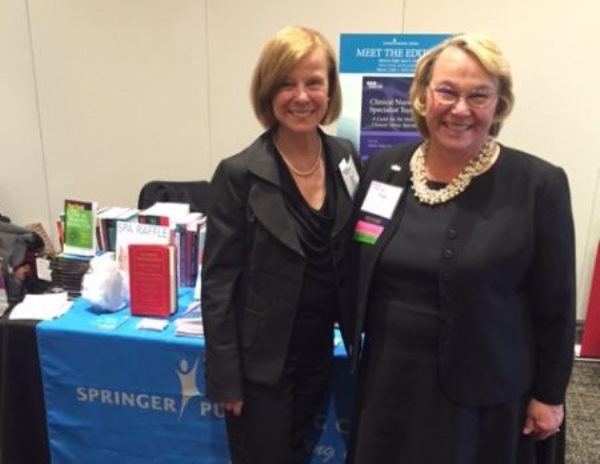
Meet our Nurse of the Week, Springer Publishing Company’s own Nursing Publisher, Margaret Zuccarini. Margaret was kind enough to share with us her background as a former nurse before her transition into publishing nursing books.
After earning her BSN from the University of Michigan in 1965, Margaret went on to work in a variety of nursing positions before taking a short career break to raise a family. A couple of years later, Margaret took advantage of her unique combination of nursing and editing experience and took a leap of faith with a new position as Freelance Nursing Editor. Today, Margaret is a Nursing Publisher for Springer Publishing Company where her role is focused on finding new market opportunities for advanced practice and doctoral nursing materials. Here Margaret provides the answers to a few of our questions about her experience both in nursing practice and publishing.
What made you decide to go into nursing?
When I was young, there were very few professional opportunities for women. In fact, there were three: teacher, secretary, and nurse! I knew I wanted to go to university and I knew I didn’t want to be a teacher or a secretary. I truly had no idea what it meant to earn a Bachelor of Science in Nursing (BSN) degree, but I went to the University of Michigan and graduated with a BSN in 1965. That BSN opened every door upon which I knocked – I loved working with patients, providing whatever comfort I could provide. Sometimes just holding a hand meant a huge difference to a patient. Providing care with respect for the individual is what I found was most important to each person.
Tell us about your nursing background.
I graduated on a Saturday and started my first position in nursing on Monday! I worked at the Women’s Hospital at the University of Michigan Medical Center for three months, until my husband and I moved to Pennsylvania where he had a 1-year appointment as an assistant professor at Dickinson College. I became a Pennsylvania State Public Health Nurse, running well-baby clinics, TB clinics, and collecting stool samples for multiple outbreaks of Salmonella (epidemiology work to help identify where such infections originated and who was infected). From Carlisle, PA, we moved to Chapel Hill, where my husband earned his PhD, and where I became a critical care nurse at the University of North Carolina Medical Center until my son was born in 1969. Next, we moved to the Eastern Shore of Maryland where I worked two evenings a week in the ER at Kent & Queen Anne County Hospital (the only hospital in two counties). In 1973, we moved north again to Glenside, PA, where my husband taught at Arcadia University. During our time in Glenside I worked various part time positions as Evening School Nurse (so my husband could stay home with our two children) at the Penn State Ogontz Campus and Long Term Care Nurse at Springhouse Nursing Home.
How did a career in nursing transition into a career as a nursing publisher?
From 1980-81, our family lived in London, UK, and I did not work. Upon our return to Glenside, I evaluated where I was in my own career after having focused primarily on my husband’s career and raising our family for several years. Feeling that I was the proverbial ‘jack-of-all-trades and master of none,’ I decided to investigate opportunities that would take advantage of my education, nursing experience, and editing experience, as I had experience editing my husband’s PhD Dissertation and two textbooks he had co-authored with colleagues at Arcadia University. I knew an editor at Springhouse Publishing Company (the company that at that time published the journal NURSING) and I asked her what I needed to do to make myself ‘marketable’ in the publishing industry. She said: ‘Send me your resume,’ so I did and had an interview two days later that I walked out of having been hired as a Freelance Nursing Editor!
I had no idea what I had just agreed to do, but I decided that I’d figure it out . . . as that is what nurses do: we problem-solve! I worked as a clinical editor for a series of books, along with perhaps eight other nurses, and it was our job to evaluate the content of many journal articles and reformat that content to become book chapters. I also updated the hallmark Nurses Drug Handbook that was published every year, gaining incredible experience doing that. I finally became aware of the importance of my seemingly disparate nursing positions, which suddenly became incredibly important in terms of informing my work as a Nursing Clinical Editor.
In 1992, I was invited to accept a position at Lippincott Williams & Wilkins (LWW) in Philadelphia as an acquisitions editor. I accepted, and for the next 17 years, developed undergrad textbooks in psychiatric-mental health nursing, nursing pharmacology, nursing research, community health nursing, and a host of ‘trends & issues’ books, many of which remain in publication today in subsequent editions! Probably my most significant work at LWW was the development of the Lippincott Nurses Drug Guide, authored by Amy Karch, a signature publication that is still published annually with the same cover design and features that were instituted in the first edition (1995). Since 2008, I have been happily acquiring graduate level product and providing strategic plans for the nursing division of Springer Publishing Company.
Can you give us a short explanation of your role at Springer?
At Springer, where my position is Publisher, Nursing, my most significant role is to identify market growth opportunities within the advanced practice (MSN) and doctoral (PhD and DNP) course and clinical practice areas. Additionally, I work with our amazing team of nursing acquisitions editors to organize and manage our acquisitions work. Each of us is assigned specific areas within which we acquire print and digital products, and App product for both textbook and clinical reference. We attend professional meetings to keep abreast of market trends, to identify qualified authors, and to engage our target market segments. Currently, we are working to develop a product line for delivery on Springer’s upcoming digital platform. Throughout the acquisition process, we review and polish proposals, present proposals to Springer’s publishing committee, work with each author throughout the manuscript development stage, approve a manuscript once it’s received, and communicate important aspects of each product to our production, sales, and marketing teams.
Tell us about a recent nursing book you enjoyed working on or an interesting trend in the nursing field you’ve noticed recently.
One of the most interesting products I’ve worked on recently was the American Indian Health and Nursing publication, authored by Dr. Margaret Moss. Dr. Moss conducted extensive research into Native American health practices and cultural traditions throughout the US, and as a registered Native American herself, was amazed to discover through her research that there are distinct differences among native American groups. In fact, she identified 9 distinct groups within the US that shared common health beliefs and practices. The book is a profoundly important work contributed to by many of the 19 PhD Native American nurses in the US who share information on health disparities and cultural traditions that are important for nurses to be aware of when working with these populations.
Thank you so much, Margaret, for taking the time to answer our questions and share your unique nursing journey and insights with us!

- Nationwide Shortage of Sexual Assault Nurse Examiners Prompts Alternative Solutions from States - March 30, 2020
- Coldiron Senior Nurse Executive Fellowship Program Established to Enhance Development of Senior Nurse Executives - March 27, 2020
- Nurse of the Week: UW-Madison Nursing Student Marcela Hanson Crowdsources Childcare Help For Local Healthcare Workers During COVID-19 Pandemic - March 25, 2020