
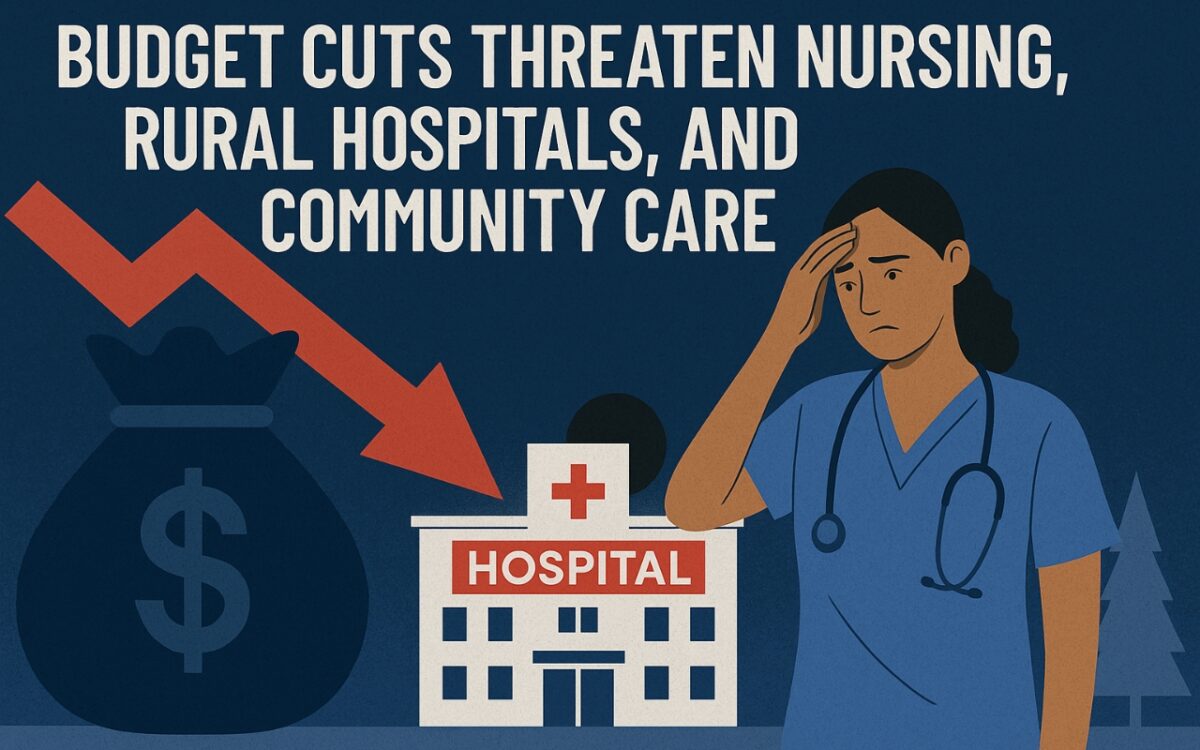
The new federal budget brings sweeping changes that could leave millions without health insurance, strain hospitals nationwide, and disproportionately harm rural communities. For nurses on the frontlines, the implications aren’t just political—they’re deeply personal and profoundly practical.
Dr. Elizabeth Sibson-Tuan, Director of the Accelerated Bachelor of Science in Nursing (ABSN) program at Samuel Merritt University in Oakland, has been a nurse for more than 40 years. She doesn’t mince words when describing the proposed changes: “nerve-wracking.”
“Budget cuts will reduce funding for hospitals, especially in rural and underserved areas,” she says. “Sixty percent of nursing is done in the community, and nurse practitioners and PAs are being used more and more for healthcare. With these financial pressures looming, elderly patients are left wondering: Will they lose their Medicare, Medi-Cal, or Medicaid? Will they be pushed out onto the streets? One possible solution is that AI can help mitigate some of these costs by streamlining nurses’ work and making tasks more efficient. In the meantime, we need to teach nursing students to properly analyze AI research and think critically about it to help with care. The more we use it, the stronger it’s going to be.”
The Big Picture: What Keeps Nurses Up at Night
For Sibson-Tuan, the fear isn’t abstract—it’s about entire communities losing access to basic care.
“What keeps me up at night is knowing that entire communities, especially in rural areas, could lose access to basic healthcare. The struggle is real: we already face major challenges recruiting nurses and providers, even with funding. Cuts only make it worse. This isn’t just about inconvenience, it’s about delayed care, worsening health and lives at risk.”
When rural hospitals lose funding, she notes, they may be forced to reduce services, close departments, or shut down entirely. That reality pushes patients to travel hours for routine care, skip preventive visits, or face dangerous delays during emergencies.
Ripple Effects Beyond the Hospital Walls
Cuts to hospital budgets don’t stay within hospital walls. With 60% of nursing care taking place in the community, the strain shifts outward.
“Cuts to hospital funding often reduce staffing and support, directly affecting nurses in community settings,” Sibson-Tuan explains. “As hospitals scale back, community care is left to absorb the overflow, often without the necessary funding to support that increased demand.”
Nurse practitioners (NPs) and physician assistants (PAs) play a crucial role in bridging access gaps, particularly in underserved areas. But budget cuts put these roles at risk.
“By investing in their roles, we can advance the goals of Healthy People 2030 and build a stronger, more equitable healthcare system for all,” she says.
In rural areas, the loss of these providers can disrupt continuity of care. Still, Sibson-Tuan remains hopeful that local partnerships, telehealth expansion, and targeted investment in NPs and PAs can help communities “keep care close to home.”
Vulnerable Populations at Greatest Risk
Older adults are particularly at risk under the proposed bill.
“Older adults are especially vulnerable… they often rely heavily on consistent, accessible care and any disruption can have serious consequences,” she says. “Many elderly patients are worried about losing Medicare, Medi-Cal, or Medicaid, but the truth is, much of the current anxiety stems from widespread uncertainty about what the legislation will actually entail.”
The Role of AI: Promise with Caution
While technology won’t solve every problem, Sibson-Tuan believes AI has the potential to ease cost pressures and improve efficiency—if implemented thoughtfully.
“AI can be a powerful tool to streamline and organize care, improving efficiency and access. But we must never oversimplify the complexity of healthcare, especially when human lives, emotions, and relationships are involved.”
Her approach is to prepare nurses not just to use AI, but to evaluate it critically.
Training Nurses for a Changing Landscape
At Samuel Merritt University, the ABSN program is designed with these realities in mind. Students experience high-fidelity simulations to build clinical judgment, train with Electronic Health Records, and collaborate in team-based care. The curriculum also emphasizes healthcare policy, systems thinking, and community-based practice.
“Together, these elements create nurses who are clinically skilled, technologically fluent, and socially responsive,” Sibson-Tuan says.
A Message for Lawmakers
If she could speak directly to policymakers, Sibson-Tuan would drive home the interconnectedness of funding and community health.
“Budget cuts in healthcare create a ripple effect that touches everyone, from the patient at the bedside to the provider delivering care. Reduced funding can limit access to essential resources, delay services, and increase the burden on already stretched healthcare teams. Yet, in the face of these challenges, nurses and providers continue to innovate, adapt, and advocate for quality care. These constraints often spark creative problem-solving and a renewed focus on collaboration and efficiency. While the impact is real, so too is the resilience of those committed to delivering compassionate, patient-centered care.”
For nurses, resilience isn’t just a buzzword—it’s a necessity. And in the face of potentially devastating cuts, that resilience will be tested more than ever.
- She Treats Addiction Through a Screen. Here’s What This Psychiatric NP Is Watching For - September 30, 2026
- She Went From Broadway to Dementia Care. Now She Helps Nurses Understand What Behavior Is Saying - September 25, 2026
- What Causes Breast Milk Supply to Drop? What Nurses Should Know - August 18, 2026