
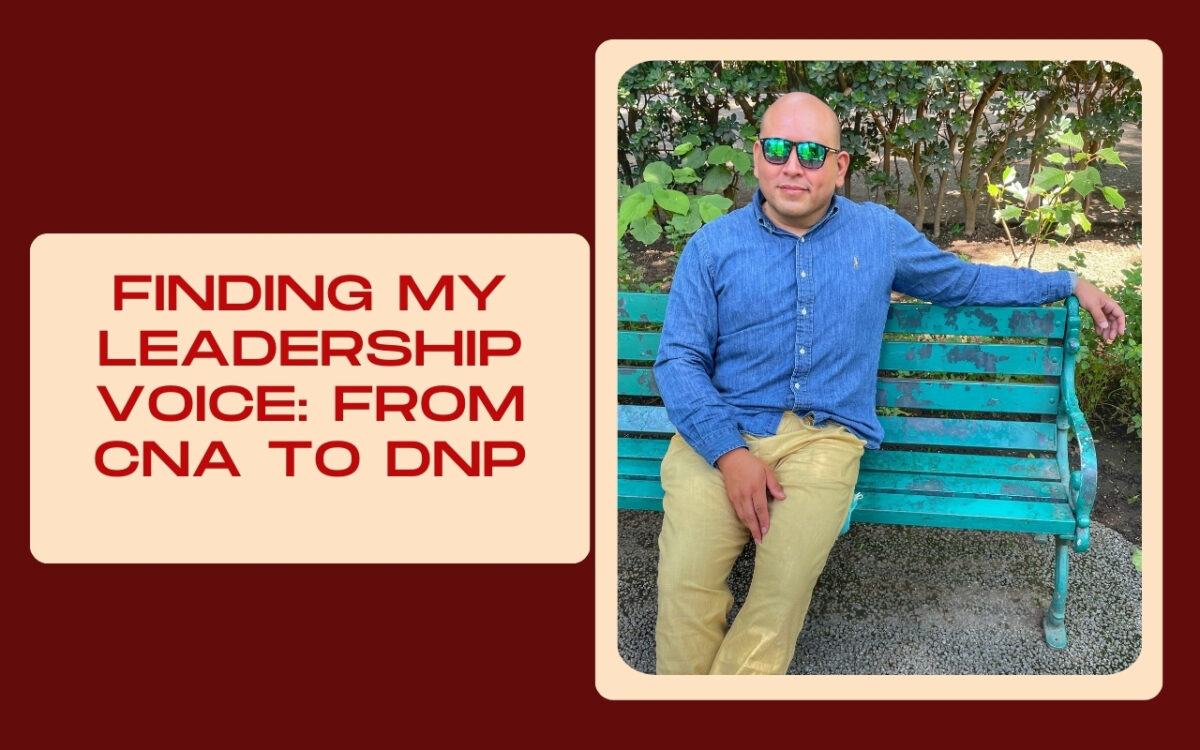
I grew up in South Texas, where English and Spanish blended in daily life. You’d hear both languages at the grocery store, at school, at church, and around the dinner table. For me, that mix of voices was normal. I never gave it much thought until I found myself in nursing leadership meetings years later.
In those rooms, I often noticed most of the people in charge did not look like me, and they did not sound like me either. Their voices carried what I thought of a polished, “professional” sound. Mine carried South Texas. For a long time, I wondered if that difference made me less of a nurse, educator or leader. What I have come to realize is the opposite, my voice, my accents, my culture, my roots, are not barriers. They are strengths. They connect me more deeply to patients, families, and colleagues. They remind others that leadership doesn’t have one “look” or “sound’. They are proof that Hispanic men can rise in nursing, step into leadership, and thrive without giving up who they are.
Starting from the Ground Floor
I didn’t begin as a nurse leader. My first step was a certified nursing assistant (CNA). Those early days were tough, long hours, heavy workloads, and very little recognition. But being a CNA taught me lessons I still carry today. I learned humility, because patient care is about serving others. I learned resilience, because the work can be physically and emotionally demanding. And I learned that patients do not care how you sound, they care that you show up, listen, and treat them with dignity.
Climbing the Nursing Ladder
From there, I advanced to become a licensed vocational nurse (LVN). That degree gave me more responsibility and a louder voice in patient care. But with that voice came a new awareness. I noticed the expectations of “professionalism,” especially in how nurses were expected to present themselves. I battled imposter syndrome, wondering if people heard my words or just the way I sometimes mispronounced words.
Earning my Associate Degree in Nursing (ADN) marked the next big step. Balancing school, work, and life was a constant challenge, but I began to see myself as more than a caregiver, I was also a professional. Still doubts lingered. I was often one of the only Hispanic men in my classes and on the unit.
Pursing my Bachelors of Science in Nursing (BSN) brought new opportunities. I served as a charge nurse, and participated in committees where decisions were made. For the first time, I felt the weight of leadership. But leadership had a certain “look” and “sound”, and mine were different. My South Texas voice did not match the voices I heard brought the leadership tables. It left me questioning if others saw me as credible.
When I went on to earn my Master of Science in Nursing (MSN), I stepped further into spaces of policy, budgeting, and administration. Here, the contrast became even clearer. Most leaders spoke in polished tones, without a trace of accent. I carried mine into every meeting, sometimes proud, sometimes self-conscious. I battled imposter syndrome, wondering if people heard my words or just the way I sometimes mispronounced words.
Finally, receiving my Doctor of Nursing Practice (DNP) was not just an academic achievement. It was the turning point where I realized that my journey, from CNA to DNP was not despite my accent and culture. It was because of them. Every step reminded me that my authentic voice was a strength, not something to hide.
The Accent
There are moments that the way I speak lifted me up. Like the patient who instantly relaxed when I spoke Spanish at the bedside. Or the family who said, “thank you for explaining it in a way we understand.” Or the younger nurses that reach out for mentorship on someone that looks and speaks like them. Those experiences taught me something powerful, my accent is not a barrier to leadership, it is a bridge. It connects me to the people I serve.
Why Representation Matters
Representation in nursing is not just about numbers, it is about trust. Nationally, Hispanic make up fewer than 7% of nurses. That means patients and families often do not picture themselves in nursing scrubs, much less in leadership roles.
But representation matters. When patients see nurses and leaders who look and sound like them, it builds connection and trust. When staff see diverse leaders, it expands their vision of what’s possible. And when young Hispanic men see someone like me, a kid from South Texas with a DNP, they can imagine their own path in healthcare.
Lessons Learned in Leadership
Along the way, I have learned lessons I want to pass on:
- Your voice matters – even when it does not match the “standard” voice in the room.
- Accents are strengths – they represent resilience, bilingualism, cultural depth.
- Diversity in leadership is essential – healthcare teams are stronger when leaders reflect the communities they serve.
- Mentorship is everything– no one climbs the ladder alone. I didn’t. Having mentors who believed in me gave me the courage to keep going.
From South Texas to my DNP, my journey has been about more than collecting degrees. It has been about finding my voice, the one that carries my community, my culture, and my authentic self into every room I walk into.
I did not sound like the average leader, and I never will. And that’s exactly why I belong here.

- Finding My Leadership Voice: From CNA to DNP - October 29, 2025