
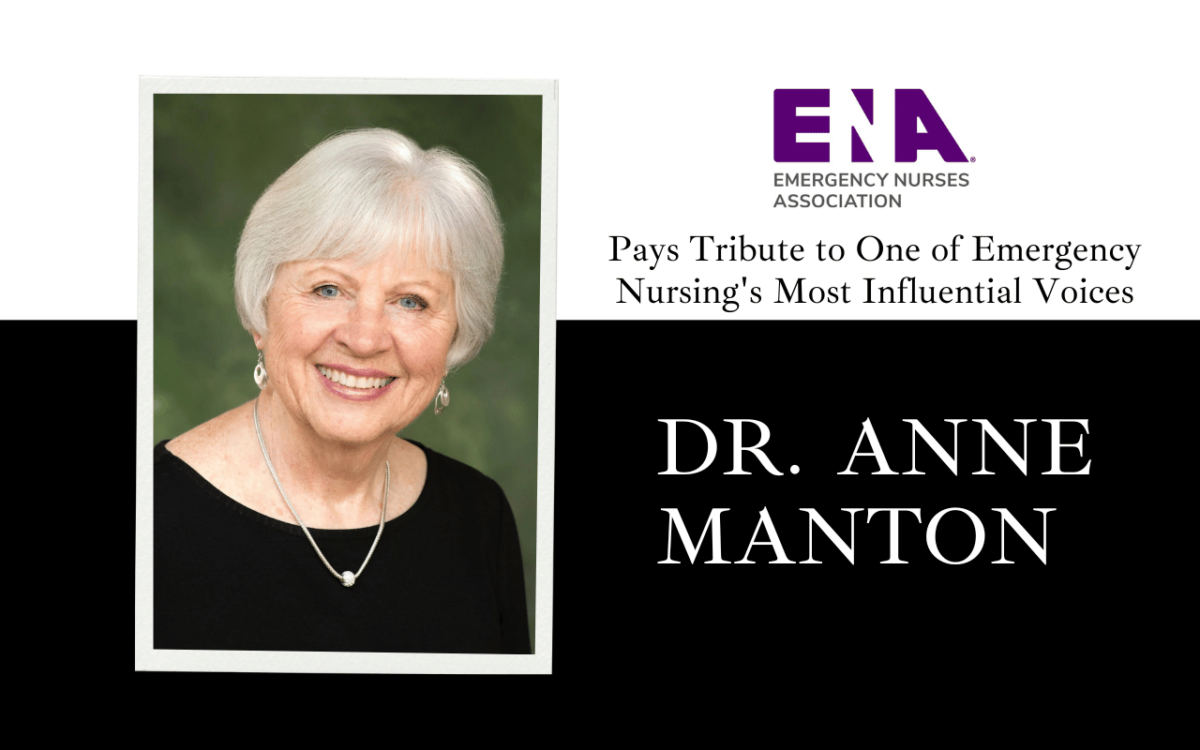
The March 2025 issue of the Journal of Emergency Nursing (JEN) delivers more than just evidence-based insights—it pays tribute to one of emergency nursing’s most influential voices, Dr. Anne Manton, who passed away in December.
Dr. Manton, a fierce advocate for emergency nurses, served as editor-in-chief of JEN from 2013 to 2018 and was president of the Emergency Nurses Association (ENA) in 1998. During her tenure, she transformed JEN into a more accessible, relevant resource for frontline nurses and led the charge to strengthen its online presence—changes that continue to shape the journal today.
“A quality I most admired about Dr. Manton was how she created safe and inclusive spaces that gave those around her a strong sense of belonging. She was an attentive listener and was intentional with her words and actions,” said current Editor-in-Chief Anna Valdez, PhD, RN, PHN, CEN, CFRN, CNE, FAEN, FAADN. “As the editor-in-chief of JEN, I strive to carry on her vision and apply the skills and lessons she taught me.”
In addition to honoring Manton’s legacy, the March issue tackles the realities many emergency nurses face on the job—including burnout, workplace violence, and resource scarcity—and offers systems-focused solutions to drive better outcomes for staff and patients alike.
Burnout and Work Engagement: A Dual Reality
One of the issue’s most eye-opening studies, “Job-Related Factors Associated with Burnout and Work Engagement in Emergency Nurses: Evidence to Inform Systems-Focused Interventions,” paints a stark picture: 53% of emergency nurses surveyed reported high levels of burnout. Notably, workplace violence emerged as a key contributor to emotional exhaustion.
Conversely, those who reported high work engagement pointed to different influences: organizational support and meaningful recognition. These findings reinforce the urgent need for hospital systems to prioritize physical safety, emotional support, and professional acknowledgment.
Adapting to Overcrowding with Innovation
In “Innovations in Emergency Nursing: Adapting Patient Flow Management to Emergency Department Overcrowding,” the author explores how emergency nurses stay agile in chaotic conditions. When faced with overwhelming patient volumes, nurses shift focus, reallocate resources, and modify staffing and workflow processes—all in real-time.
This study highlights the ingenuity and adaptability of ED nurses and their critical role in patient throughput, safety, and quality of care.
Understanding Violence Against Health Care Workers
Another study, “Factors Influencing the Intention of Family Members of Patients Admitted to Emergency Departments to Commit Violence Against Health Care Professionals,” reveals that while the overall intention to commit violence remains low, certain stressors—such as lack of information, not being able to see a loved one, or being excluded from the care process—can heighten the risk.
These findings underscore the importance of transparent communication and family engagement in emergency settings to safeguard both caregivers and patients.
A Call to Action for Emergency Nursing Leaders
The March issue of JEN delivers crucial data-driven insights and a powerful reminder of what’s possible when leadership, research, and frontline voices come together. Whether through system-level interventions to reduce burnout or innovative strategies to manage ED flow, the future of emergency nursing demands thoughtful, evidence-based action.
As the legacy of Dr. Anne Manton reminds us, the most lasting change often begins with listening, inclusion, and a clear vision of what nursing can be.
