
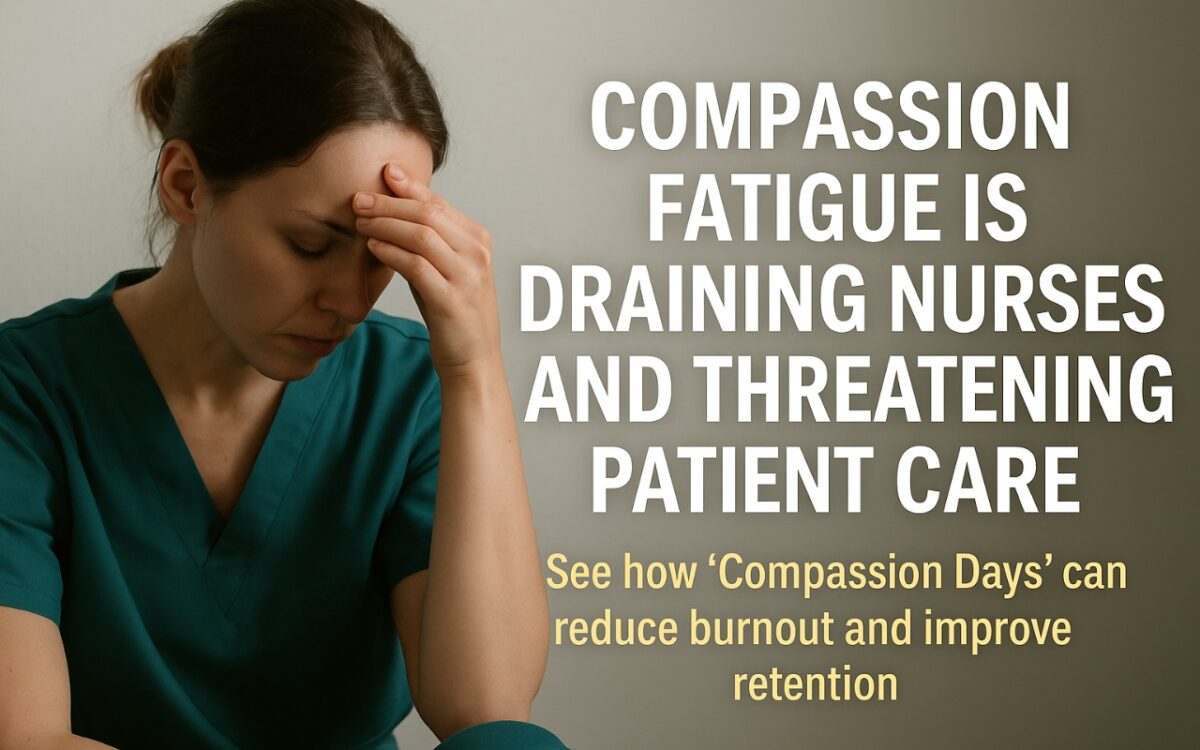
In healthcare, we often focus on staffing shortages, quality metrics, and rising costs. Yet we rarely address the silent epidemic that threatens all three: compassion fatigue. For nurses, compassion fatigue is more than burnout or stress. It is the deep emotional, physical, and spiritual exhaustion that comes from providing continuous care to patients in distress without adequate recovery.
The data are sobering. More than half of nurses report experiencing compassion fatigue since the COVID-19 pandemic. Each nurse lost to turnover costs hospitals an estimated $40,000–$60,000, excluding the costs of recruiting, training, and the ripple effect on team morale. Beyond the numbers, compassion fatigue erodes the very core of patient care. Nurses who are exhausted emotionally and physically are more likely to make mistakes, call out sick, and disengage from both their profession and their families at home.
I know this not only from research but also from personal experience. After 13 years as a nurse, I have seen colleagues who leave their shift too drained to embrace their children, too weary to laugh with their spouse, and too numb to feel pride in the work they once loved. This is not weakness—it is a natural human response to relentless exposure to suffering without reprieve.
Why the Status Quo is Failing
Our system has traditionally told nurses to “push through.” Mandatory overtime, crisis staffing, and lean budgets force frontline clinicians to give more and more of themselves while receiving little structured support in return. Hospitals scramble to offer resilience webinars or yoga sessions, but these short-term fixes rarely address the systemic nature of the problem.
Ignoring compassion fatigue has measurable consequences. It drives turnover, weakens retention, compromises patient outcomes, and places a burden on families. In an era where healthcare already faces critical shortages, failing to address this issue is a leadership risk no executive can afford to ignore.
Introducing Compassion Days
We need a workforce intervention that acknowledges the unique demands of caregiving. One such innovation is the idea of Compassion Days—structured, restorative time off distinct from PTO or sick leave. Compassion Days recognize that caring for others in trauma-heavy environments drains not only the body but also the spirit.
Here’s how it could work:
- Eligibility Triggers: Compassion Days could be activated after repeated overtime, crisis events, or unit-level debriefings.
- Coverage: Relief staff, agency nurses, or internal float pools would cover these shifts, ensuring continuity of care.
- Documentation: Compassion Days would be tracked separately from PTO, allowing organizations to measure their impact on retention, engagement, and sick call rates.
Far from being a luxury, Compassion Days represent a safety intervention. They give nurses permission to step back, recharge, and return to practice more present, more engaged, and less likely to make costly errors.
The Business Case for Leaders
For executives and policymakers, the case is clear: Compassion Days are not only humane, they are financially smart. Consider a midsize hospital with 500 nurses. If even 10% of turnover is prevented by introducing Compassion Days, the organization could save $2–3 million annually—while also improving patient satisfaction, reducing errors, and building a reputation as an employer of choice.
Early pilots could be launched in high-stress areas such as emergency departments, ICUs, or oncology units. Outcomes can be measured over 6–12 months using metrics such as turnover rates, engagement surveys, and quality indicators. Within one year, leaders would have data to justify scaling across the organization.
A Call to Action
Compassion fatigue will not disappear on its own. The longer we ignore it, the more it undermines our workforce and compromises the care patients receive. Hospitals, health systems, and policymakers must recognize compassion fatigue as both a workforce stability issue and a patient safety issue.
Compassion Days are one step toward a solution. They will not solve every challenge of nurse burnout, but they send a powerful message: we value the humanity of our workforce as much as the health of our patients.
Healthcare executives frequently discuss innovation, transformation, and resilience. Here is a chance to lead by example. The cost of inaction is too high, and the solution is within reach.
Nurses are the backbone of healthcare. If we do not protect their well-being, we risk losing the very heart of the system. The time for Compassion Days is now.